
1. Psychrometric Baseline in Unconditioned Florida Attics
In hot-humid building science, the unconditioned, ventilated residential attic is one of the most hostile operating environments for forced-air distribution systems. Solar radiation loads on concrete tile and asphalt shingle roof decks routinely generate attic ambient temperatures ranging from 120°F to 135°F (48.8°C to 57.2°C) with concurrent relative humidity ($RH$) levels between 65% and 85%.
A properly operating direct-expansion (DX) residential cooling system delivers conditioned supply air at 52°F to 55°F. When flexible ductwork suffers from gravitational compression, fiberglass degradation, or micro-punctures in the outer jacket:
- The outer metallized vapor barrier drops to 60°F – 68°F, which is over 40°F below the attic ambient dew point.
- Water vapor instantly condenses into liquid form across the cylindrical foil surface at an accelerated rate (*Vapor Condensation Rate*).
- Standing water saturates ceiling insulation below and creates the micro-environment required for saprophytic fungi (*Cladosporium herbarum* and *Penicillium chrysogenum*).
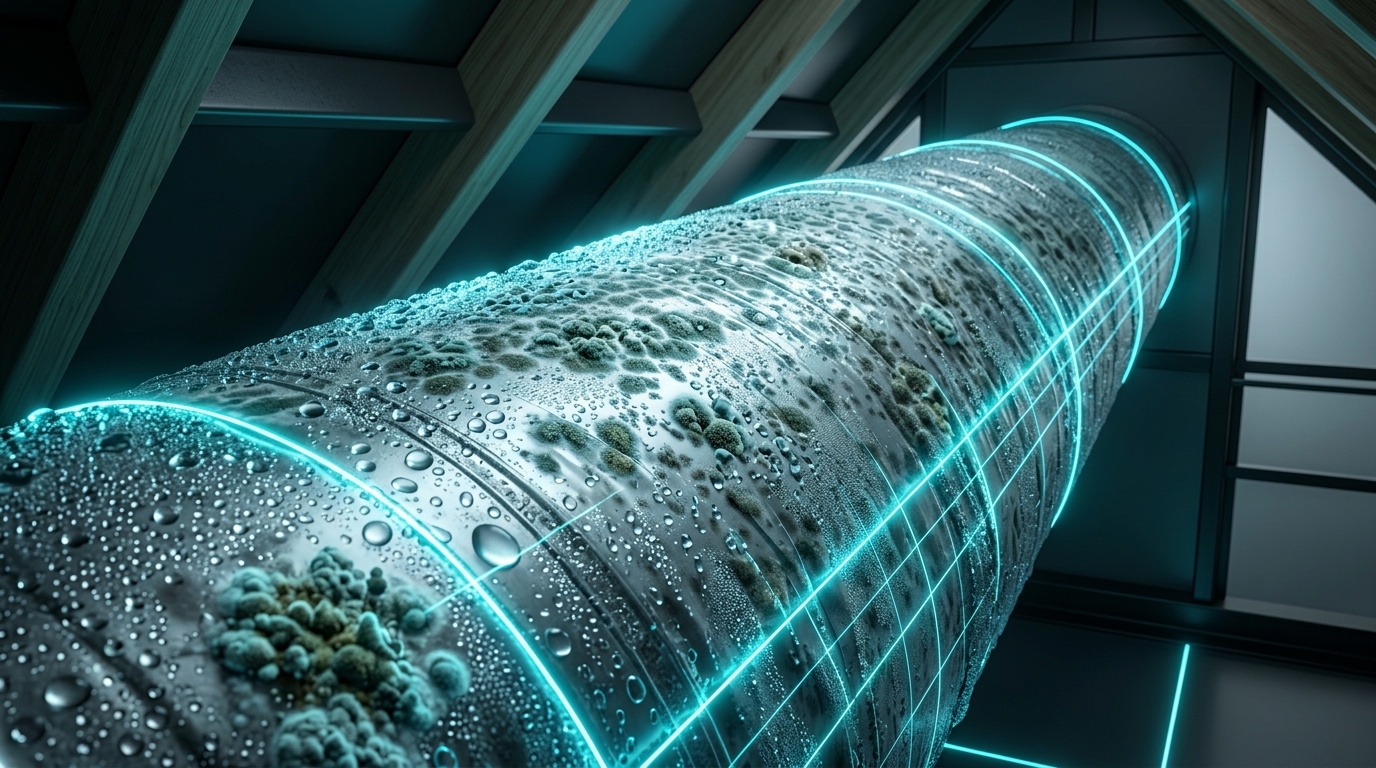
Figure 1: 3D scientific visualization of flexible HVAC duct sweating in an unconditioned attic, illustrating thermal bridging and fungal colonization on the outer vapor barrier.
2. Pressure Dynamics & The Off-Cycle Infiltration Loop
A frequent diagnostic oversight during property inspections is concluding that the failure is isolated to the outer jacket. Fluid dynamics and vapor pressure differentials prove that outer barrier degradation leads directly to internal core colonization:
The 3-Phase Off-Cycle Contamination Mechanism:
- Steep Vapor Pressure Gradient: Attic air at 125°F/70% RH exerts a high partial water vapor pressure (~2.7 psi) compared to indoor supply air (~0.4 psi). This steep gradient drives water vapor inward through micro-punctures, unsealed collars, and deteriorated tape seams.
- Off-Cycle Siphon Effect: When the blower motor shuts off, positive static pressure (+25 to +50 Pa) vanishes. As stagnant cold air inside the duct warms, convective attic air currents draw unfiltered, spore-laden attic air straight into the inner core.
- Inner Core Dewing & Biofilm Formation: Upon the subsequent cooling cycle, a fresh blast of 52°F air slams into the humid air mass. Moisture condenses directly onto the internal wire helix and corrugated liner, binding accumulated household dust into an active fungal matrix.
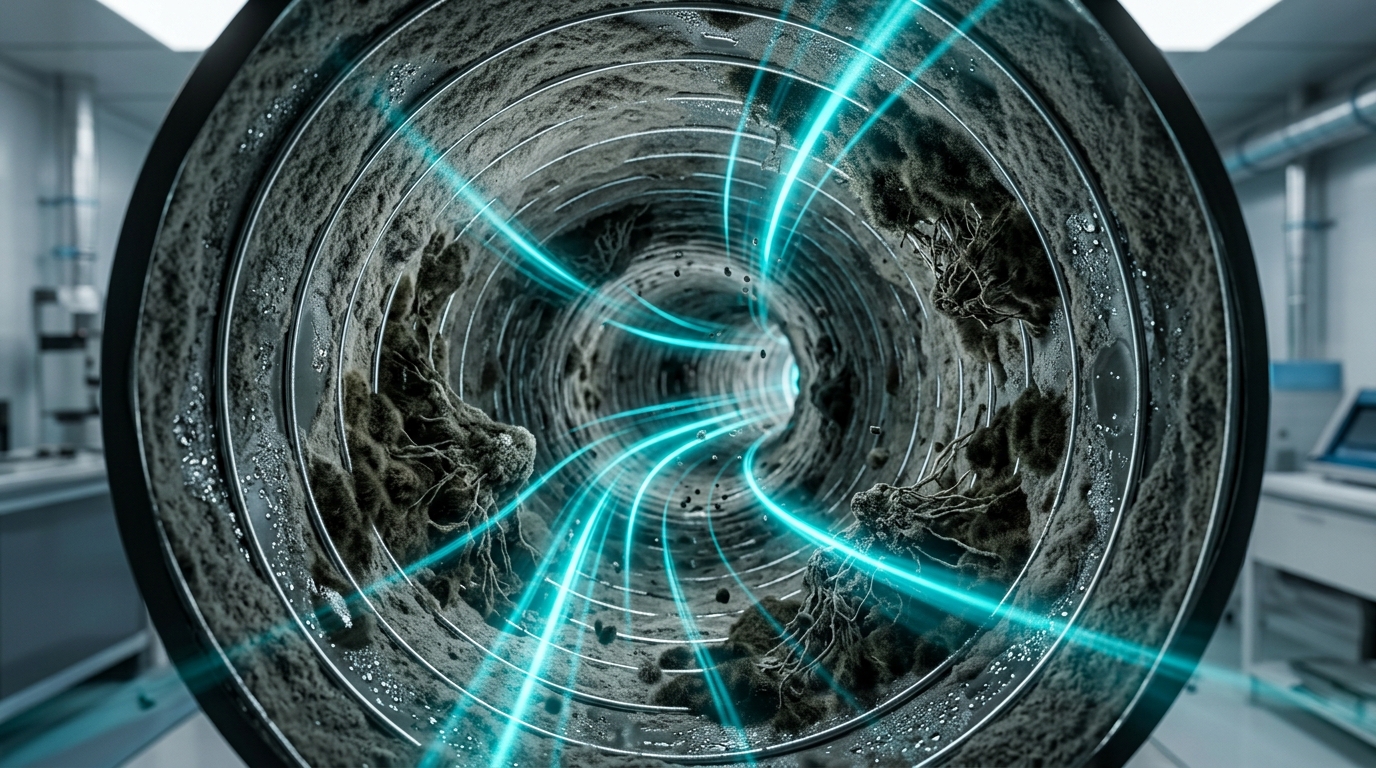
Figure 2: Microscopic internal view of flexible ductwork. Moisture condensation and dust sediment create an active fungal colony along the wire helix, dispersing spores into the living room air stream.
3. Taxonomic Mycological Ecology & Pathogen Profile in HVAC Ducts
During environmental building assessments, laboratory fungal identification from air cassettes (Air-O-Cell) and direct tape-lift samples of sweating flex ducts reveal a distinct ecological succession. Flexible ductwork provides three necessary variables for fungal amplification: prolonged elevated relative humidity / condensed water, complete darkness, and an abundant organic nutrient bed comprised of settled skin cells, textile fibers, and cellulose-rich dust.
| Fungal Genus & Species | Water Activity ($a_w$) & Thermal Range | Duct Substrate & Niche | Secondary Metabolites (MVOCs / Toxins) | Clinical & Building Ecology Risk |
|---|---|---|---|---|
|
Cladosporium (C. cladosporioides, C. sphaerospermum) |
$a_w \ge 0.85$ 10°C – 35°C (Mesophilic) |
Exterior vapor barrier foil, fiberglass scrim, diffuser boots, and supply register louvers. | Aliphatic alcohols, ketones; moderate MVOC profile. | Primary Aero-Allergen: Induces rapid IgE-mediated rhinitis, severe asthma exacerbation, and conjunctivitis. Primary agent of black vent staining. |
|
Penicillium (P. chrysogenum, P. brevicompactum) |
$a_w \ge 0.78 - 0.82$ 5°C – 37°C (Wide thermal tolerance) |
Internal duct liner dust film, inner wire helix crevices, fiberglass binder resin. | 1-octen-3-ol, geosmin, 2-methylisoborneol; Citrinin, Roquefortine C, Ochratoxin A. | "Dirty Sock Syndrome" Engine: High MVOC emissions cause foul persistent odors. Ultra-small spores (2–3 µm) reach pulmonary alveoli, causing chronic coughing and hypersensitivity pneumonitis. |
|
Aspergillus (A. niger, A. versicolor, A. flavus) |
$a_w \ge 0.75 - 0.80$ 15°C – 55°C (Thermotolerant xerophile) |
Settled particulate inside flex runs; thrives during 120°F+ attic off-cycles. | Sterigmatocystin (precursor to aflatoxin), Aflatoxins, Ochratoxin A, endotoxin-like glucans. | High-Toxicity Threat: Etiologic agent of Allergic Fungal Sinusitis (AFS) and invasive pulmonary aspergillosis in immunocompromised occupants; potent mycotoxin producer. |
|
Wallemia & Alternaria (W. sebi, A. alternata) |
$a_w \ge 0.75$ (Wallemia) $a_w \ge 0.88$ (Alternaria) |
Return air plenum boxes, particulate cake on filter frames, and damp flex connections. | Alternariol (AOH), Altenuene (ALT), Walleminol. | Pediatric Asthma Driver: Clinically established association with acute, life-threatening asthma in children; high allergenicity even in dead spore fragments. |
|
Stachybotrys & Acremonium (S. chartarum, A. strictum) |
$a_w \ge 0.90 - 0.94$ (Requires >72h saturated water) |
Sagging flexible duct bellies with standing water pools, water-saturated drywall underneath. | Macrocyclic trichothecenes (Satratoxins G & H), Verrucarin J, Roridin E. | Condition 3 Biohazard: Neurotoxic symptoms, chronic inflammatory response syndrome (CIRS), extreme transaction liability, immediate property underwriting failure. |
Inhalation Aerodynamics: Spore Micrometry vs. HVAC Airflow
HVAC airflow velocities in flexible branch ducts range from 400 to 700 feet per minute (FPM). Under laminar and turbulent flow conditions inside a vibrating flexible duct, fungal conidia detach through aerodynamic shearing forces.
While outdoor pollen and large molds (10–50 µm) are filtered by upper nasal hairs and mucosal linings, Penicillium and Aspergillus spores possess an aerodynamic diameter ($d_{ae}$) between 2.0 µm and 3.5 µm. This critical size allows the spores to bypass the human nasopharynx entirely and penetrate directly into the deep terminal bronchioles and alveolar sacs, inducing chronic pulmonary remodeling and systemic inflammation.
4. Technical Comparison: Exterior Failure vs. Internal Core Contamination
| Diagnostic Metric | Exterior Vapor Barrier Failure | Internal Core Colonization |
|---|---|---|
| Root Mechanism | Thermal resistance breakdown ($R < T_{dp}$). | Off-cycle vapor drive & inner core thermal shock. |
| Visible Pathology | Beaded water droplets, blotchy mold spots on jacket. | Black ring staining on ceiling registers, boot corrosion. |
| Dominant Fungi | Cladosporium, Alternaria feeding on attic dust. | Aspergillus niger/versicolor, Penicillium, hyaline spores. |
| IAQ Impact | Indirect (unless ceiling drywall collapses). | Critical (IICRC Condition 3): Continuous spore aerosolization. |
| NADCA ACR Standard | Cleanable & re-insulatable if inner core is intact. | Mandatory Section Removal: Mechanical brushing prohibited. |
| Real Estate Impact | Repair credit or minor inspection objection. | Failed 4-Point Inspection / Insurance Underwriting Denial. |
5. Code Compliance, Standards & Transaction Liability
Florida Building Code (FBC-EC)
The Florida Building Code (Energy Conservation) mandates an absolute minimum of R-8 insulation on all supply and return ducts in unconditioned attics.
All connections must be mechanically fastened and sealed with UL 181A-M or UL 181B-M mastic systems. Conventional cloth duct tape fails within 24–36 months under attic heat exceeding 110°F and is code-prohibited.
NADCA ACR & IICRC S520
The NADCA ACR Standard strictly defines flexible ductwork as a porous/semi-porous assembly.
Mechanical rotary brushes are prohibited on colonized flex duct. Brushing rips the thin polyester liner, shredding fiberglass backing and releasing toxic fibers into the building envelope. When flexible ducts develop internal mold, full removal and replacement under containment is the only acceptable protocol.
5. Sani Effect Engineered Remediation Protocol
For HVAC mechanical contractors, home inspectors, and real estate professionals requiring an auditable, clinical-grade solution:
-
Precision Diagnostic Mapping: Calibrated FLIR infrared thermography, psychrometric dew point calculations at the plenum, and surface tape-lift sampling to identify fungal species.
-
Surgical Removal Under Negative Pressure: Containment protocols isolate colonized flex runs, preventing attic insulation and structural lumber cross-contamination.
-
Installation of Sani BlueDuct R-8 (Agion® Technology): Replaced with R-8 thermal barrier jackets and embedded inorganic silver and copper ions (EPA Registered & GREENGUARD Gold) to suppress bacterial and fungal biofilm growth 24/7.
-
UL 181 Mastic Encapsulation: All take-offs, collar joints, and register boots sealed with non-shrinking mastic paste, achieving duct leakage rates below 3%.
-
Continuous Active Purification: Installation of ActivePure® Advanced Photohydrolysis Technology directly in the air handler to neutralize 99.9% of airborne pathogens throughout the building volume.
Integrated Engineering & Remediation Solutions
Contractors, inspectors, and engineers can coordinate remediation and preventative replacements directly through Sani Effect's certified clinical divisions:
Sani BlueDuct System
R-8 thermal resistance with Agion® embedded antimicrobial ions. Permanent prevention of attic sweating and biofilm growth.
Product Specs & Turn-Key InstallationAir Duct Remediation
Non-destructive pneumatic whips, HEPA negative air staging, and hospital-grade botano-chemical sanitization.
Remediation ProtocolClimate Risk Simulator
Interactive psychrometric engine calculating dew point, water activity ($a_w$), and fungal amplification windows.
Launch Risk SimulatorPartner with Sani Effect Environmental
Are you a Home Inspector, HVAC Contractor, or Real Estate Broker managing a transaction with duct condensation or mold objections? Leverage our engineering team for definitive diagnosis and swift remediation.