
The Unseen Hazard in Florida’s Pristine Luxury Residences
When moving into a newly constructed multi-million-dollar waterfront estate in Palm Beach, a modern penthouse in Boca Raton, or an expansive custom home in Jupiter, families anticipate absolute architectural perfection. High-volume ceilings, seamless finishes, designer cabinetry, and spa-grade primary bathrooms create an ambiance of spotless luxury.
In South Florida's humid coastal environment, homeowners and general contractors vigilantly protect against biological threats—monitoring relative humidity, filtering outdoor allergens, and selecting zero-VOC paints. However, certified forensic environmental investigations frequently uncover an aggressive, inorganic physical contaminant that slips completely undetected past building code officials: microscopic synthetic vitreous fibers (SVFs) actively sheared from unsealed, exposed fiberglass duct board cuts.
Why Newly Built Luxury Homes Are Most At Risk:
Unlike older homes with standard stamped-steel louvered registers, modern architectural masterpieces utilize flush-mounted linear slot diffusers. Because these long, narrow registers require customized plenum boxes fabricated manually on-site from rigid fibrous glass duct board, human installation cuts routinely leave the raw, fibrous insulation core directly exposed to hurricane-velocity supply airflow.
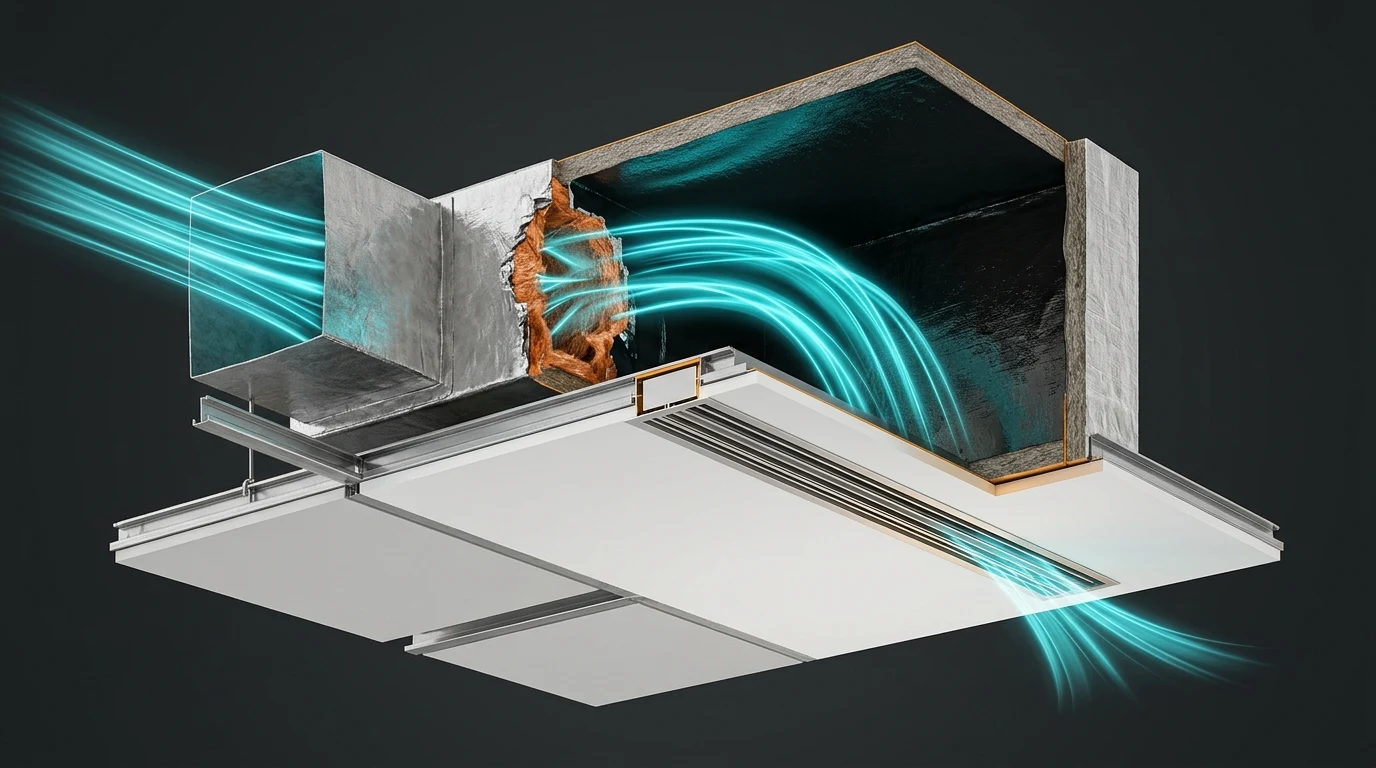
Figure 1: Architectural Forensic Cutaway: Ceiling Linear Slot Diffuser & Custom Duct Board Plenum. The factory black protective scrim (top) shields bonded glass fibers, but manual cuts and metal bracket screws expose the raw orange fiberglass core directly into the high-velocity supply airstream.
Full SizeThe Anatomy of the Defect: What Lies Behind the Grille
To understand how this defect develops, one must understand how custom air distribution boxes are constructed. Rigid fibrous glass duct board (such as Johns Manville Micro-Aire® or Owens Corning QuietR®) is a dense thermal acoustic insulation panel widely used across commercial and residential HVAC installations.
Factory-manufactured duct board panels feature a dual-surface construction:
1. The Factory Interior Scrim (Protected Surface):
The air-facing side of premium duct board is factory-coated with a tough, reinforced black acrylic composite mat (scrim).
- Completely seals and encapsulates the glass core.
- Provides an ultra-smooth, low-friction aerodynamic air path.
- Tested to withstand air velocities exceeding 5,000 FPM without fiber erosion under ASTM C1071 standards.
2. The Raw Fiberglass Core (The Hazard):
Directly beneath the paper-thin black skin lies the raw yellow or orange fibrous glass matrix.
- Composed of millions of microscopic synthetic vitreous silica filaments.
- Highly friable—readily shatters, fractures, and sheds when exposed to moving air.
- Extremely porous—absorbs moisture, volatile dust, and fungal spores like an open sponge.
Where Job-Site Installation Fails Building Science
Linear slot diffusers do not come pre-attached to factory duct boxes. Instead, mechanical rough-in crews on construction job sites measure the ceiling opening, use utility knives to slice rectangular supply boot boxes from raw duct board sheets, and secure metal linear diffuser frames into the ceiling drywall using long self-tapping sheet metal screws.
The 3 Critical Installation Failures:
- Unsealed Throat Cuts: The utility knife cuts right through the protective black scrim, leaving raw, fuzzy orange fiberglass edges completely unsealed inside the supply neck.
- Penetrating Mounting Screws: Long metal screws driven directly through raw insulation crush and fracture brittle glass filaments, creating constant vibration micro-fractures every time the air handler kicks on.
- Omission of Mastic Encapsulation: HVAC rough-in crews rarely take the time to brush elastomeric duct mastic over internal cuts before the trim grille is snapped into place, hiding the defect behind sleek aluminum louvers.
| Duct Component | Factory-Treated Duct Board Surface | Unsealed On-Site Installation Cuts |
|---|---|---|
| Surface Barrier | Reinforced, bonded black acrylic polymer scrim | Raw, exposed vitreous glass fiber core |
| Erosion Threshold | Withstands > 5,000 FPM air velocity without shedding | Erodes continuously at velocities as low as 400 FPM |
| Moisture Permeability | Vapor-resistant; water beads on surface | Hydrophilic capillary action wicks moisture into insulation |
| Biological Susceptibility | Treated with fungistatic antimicrobial agents | Traps drywall dust & moisture, breeding mold colonies |
| Filtration Protection | N/A (Intact container) | Downstream of filter—zero filtration protection |
How Your HVAC System Becomes an Aerosol Nebulizer
In residential HVAC engineering, the air handling unit is the true cardiovascular and respiratory system of the home. When raw, unsealed fiberglass edges remain exposed within supply diffusers, three continuous mechanical forces convert the cooling system into an efficient fiber distribution machine:
High-Velocity Shearing
Linear slot diffusers feature narrow discharge openings (often 0.5" to 1.5" wide). As 800 to 1,200 CFM of supply air is forced through these constrictions, velocity spikes past 1,000 FPM. This shearing action continually tears brittle glass fibers from raw cut edges.
Thermal Fatigue Cycling
During active cooling, the air handler blasts 52°F–55°F conditioned air. When the thermostat satisfies, the boot warms to 78°F ambient ceiling temperature. This endless thermal expansion and contraction causes micro-fractures in unprotected glass fibers.
Downstream Generation
Even if your home features hospital-grade MERV 16 filtration or HEPA media at the air handler, the filter sits on the return side. Supply boot cuts are located at the terminal exit points—showering fibers directly into rooms with zero barrier.

Figure 2: Synthetic Vitreous Fiber Shearing & Deep Lung Alveolar Deposition. High-velocity forced air shears needle-sharp silica filaments from unsealed duct cuts. Particles smaller than 3.5 microns bypass nasal filtration, penetrating directly into alveolar sacs to trigger chronic respiratory inflammation.
Full SizeHealth Hazards: Why Synthetic Vitreous Fibers Do Not Belong in Your Breathing Zone
Fiberglass is chemically categorized as a Synthetic Vitreous Fiber (SVF). Unlike organic biological contaminants such as pollen, pet dander, or dust mites, fiberglass is an inorganic, non-biodegradable mineral silicate. When aerosolized, each microscopic fiber functions as a needle-sharp, rigid glass spear:
1. Respiratory Epithelial Micro-Abrasion:
Larger inhaled fibers (> 5 microns) lodge in the mucosal membranes of the nasal passages, pharynx, and trachea.
- Persistent Dry Hack: Occupants experience an incurable throat tickle that intensifies overnight or when the AC runs continuously.
- Chronic Hoarseness: Direct mechanical abrasion of the vocal cords and laryngeal folds.
- Refractory Allergies: Patients take antihistamines, nasal corticosteroids, and decongestants with zero relief, because the irritant is physical glass rather than biochemical histamine.
2. Alveolar Penetration & Bronchospasms:
Respirable glass filaments (< 3.0 microns in aerodynamic diameter) penetrate past the ciliated mucosal elevator into deep alveolar air sacs.
- Severe Asthma Exacerbations: Glass shards trigger acute bronchospasms, requiring increased bronchodilator rescue inhaler usage.
- Alveolar Macrophage Activation: Lungs attempt to engulf glass particles, resulting in localized pulmonary inflammation and chronic fatigue.
- Vulnerability in Children & Infants: Developing respiratory systems inhale a higher volume of air per pound of body weight, dramatically increasing particulate deposition.
3. Contact Dermatitis & Bedding Colonization:
As forced air discharges downward from ceiling linear diffusers, dense glass dust settles onto horizontal surfaces—bedding, pillows, sofa upholstery, and bathroom bath towels. Family members develop mysterious prickling sensations, localized erythema (redness), and intense nighttime itching that mimics scabies, bed bugs, or synthetic detergent allergies.
4. Mechanical Conjunctivitis (Gritty Eyes):
Airborne fiberglass landing on the moist ocular surface causes physical micro-abrasions to the delicate corneal epithelium and conjunctival membranes. Occupants suffer from chronic bloodshot eyes, burning, excessive lacrimation (tearing), and a distinct "sand-in-the-eye" grittiness upon waking up.
The Double Threat: How Exposed Fiberglass Becomes a Toxic Mold Incubator
In South Florida's sub-tropical climate, high ambient humidity creates a secondary, catastrophic complication. While the factory black scrim on duct board serves as a vapor-retarding barrier, raw fiberglass insulation has an open, porous structure with immense surface area.
The Hydrophobic Breakdown & Fungal Colonization Cycle:
During Florida summers, unconditioned ceiling cavities and attic spaces routinely reach 80% to 95% relative humidity. When chilled 54°F air discharges through unsealed linear diffusers, the temperature of the duct boot drops below the ambient dew point temperature:
- Capillary Moisture Absorption: Open glass fibers wick condensed water droplets directly into the insulation core like a dry kitchen sponge.
- Construction Dust Food Source: During new home construction, sheetrock dust (gypsum and starch), tile mortar powder, and sawdust settle into open duct boots. This organic cellulose debris provides abundant nutrition for fungal organisms.
- Fungal Bloom: Moisture + cellulose food + complete darkness behind the register grille creates the perfect incubator for aggressive toxigenic molds—predominantly Aspergillus niger, Penicillium chrysogenum, and Cladosporium sphaerospermum.
Homeowners who believe they are only fighting a physical dust problem suddenly find their home contaminated with a dual biological-chemical hazard: friable glass fibers carrying volatile mycotoxins and fungal spores directly into indoor air.
The Sani Effect Protocol: Engineering True Environmental Wellness
Superficial cleaning methods—such as basic duct sweeping or chemical deodorizer fogging—cannot solve this problem. Rotary brushes shred raw fiberglass further, and liquid sprays cannot bind friable mineral filaments under high static pressure.
At Sani Effect Environmental, our licensed building scientists and environmental technicians execute an engineered three-phase remediation protocol compliant with ANSI/IICRC S520 and NADCA ACR Standards:
Phase 1: Negative-Pressure HEPA Critical Extraction
Before applying any sealant, all residual construction debris, plaster dust, and friable fiberglass shards must be extracted. We establish localized negative air containment and deploy medical-grade HEPA vacuum extractors equipped with certified 99.97% DOP filtration at 0.3 microns.
- Removes all loose silica fibers without cross-contaminating living spaces, bedding, or furniture.
- Critical contact vacuuming of internal register throats, metal damper linkages, and mounting brackets.
- Static pressure containment prevents dislodged fibers from blowing into adjacent ceiling joist cavities.

Figure 3: Precision Polymeric Encapsulation with Fiberlock IAQ 8000. Certified technicians apply an elastomeric, zero-VOC acrylic composite barrier over raw cut duct board edges. The cured matrix locks in all glass filaments, resisting air velocities beyond 5,000 FPM and inhibiting fungal growth.
Full SizePhase 2: Hermetic Polymeric Encapsulation with Fiberlock IAQ 8000
We permanently encapsulate and seal all raw, exposed orange fiberglass cuts, throat seams, and mounting screw penetrations using Fiberlock IAQ 8000—a premium, 100% acrylic elastomeric polymeric coating engineered specifically for HVAC duct systems:
Permanent Fiber Lockdown:
Deeply penetrates and binds loose glass filaments into a monolithic, rubberized composite shell.
Velocity-Proof Membrane:
Exceeds ASTM C1071 airflow standards, withstanding velocities past 5,000 FPM without chipping or peeling.
EPA Fungistatic Defense:
Infused with broad-spectrum antimicrobials that prevent mold colonization even under continuous condensation.
Phase 3: 24/7 Whole-Home Molecular Environmental Purification (ActivePure® Technology)
To ensure whole-home biological security, Sani Effect integrates ActivePure® Advanced Photohydrolysis Technology directly into the central supply plenum. While passive filters wait for air to circulate back to the return, ActivePure® works proactively:
- Converts ambient microscopic moisture molecules into friendly, sub-microscopic hydroperoxide oxidizers.
- Continuously disperses through supply ductwork into every cubic foot of living space at the speed of airflow.
- Neutralizes 99.9% of bacteria, viruses, airborne mold spores, volatile chemical compounds, and ultrafine suspended particles both in the air and on all physical surfaces 24 hours a day.

Figure 4: ActivePure® Advanced Photohydrolysis Technology Whole-Home Integration. An in-duct ionization module continuously generates sub-microscopic purifying oxidizers that travel through supply ductwork to decontaminate indoor air and physical surfaces across every room 24/7.
Full SizeThe 5-Minute Homeowner Diagnostic Checklist
If your home was constructed within the last 5 years or recently underwent a luxury interior renovation featuring linear slot diffusers, check your home for these 5 telltale warning signs:
1. Visual Inspection Inside the Diffuser Slot
Shine a high-powered flashlight straight up into the narrow diffuser slots. If you see fuzzy, unsealed orange or brown wool-like fibers behind the black surface or around mounting screws, your supply duct is actively shedding glass.
2. Sunbeam "Glitter" or Tyndall Effect
In rooms with direct morning sunlight streaming through windows, observe airborne particles. If you notice shiny, needle-like specks that glitter or sparkle when the AC fan cycles on, inorganic glass filaments are suspended in the air.
3. Unexplained Nighttime Skin Prickling
Family members experience pinprick itching sensations, unexplained skin flushing, or localized rashes when sleeping on freshly laundered bedding or using bath towels stored near linear ceiling vents.
4. Chronic Morning Hoarseness & Dry Cough
Waking up with a rasping, dry throat tickle and hoarse voice that slowly clears after drinking warm water or spending hours away from the residence (e.g., at the office or outdoors).
5. High-Efficiency Filters Show Zero Discoloration
Your return air filter looks surprisingly clean, yet furniture surfaces and electronic screens gather fine, crystalline dust within days. This confirms the particulate source is located downstream of the return filter inside the supply plenum boots.
Forensic Questions About Duct Fiberglass & Linear Diffusers
Do Not Let Exposed Duct Fiberglass Compromise Your Luxury Home
If you have moved into a new build, finished a major renovation, or notice unexplained respiratory irritation, coughing, or itchy skin, contact Sani Effect Environmental. Our licensed building scientists provide precision endoscopic duct inspections and permanent polymeric encapsulation across Martin, St. Lucie, and Palm Beach Counties.