
Making your home cooler and more energy-efficient during South Florida's relentless summer heat is an excellent decision. However, there is a dark environmental secret lurking in the space nobody likes to talk about: your attic.
When you decide to remove old thermal insulation—whether faded R-30 fiberglass batts or blown-in cellulose—you are disturbing decades of accumulated particulates. If this removal process is not conducted under strict scientific and engineering protocols, what was intended to improve your quality of life can quickly mutate into a systemic contamination nightmare affecting your family's lungs, your pets, and your air conditioning system for months or years.
In this guide, written specifically for Florida homeowners by the environmental engineers at Sani Effect, we break down the cellular science of insulation risks, reveal real South Florida case studies, and outline exact protocols to safeguard your property permanently.
1. The Problem: Florida Attics & Your HVAC's Vulnerability
South Florida (designated as Climate Zone 1A: Very Hot & Humid by the Florida Building Code) subjects residential structures to extreme thermal loads. In peak summer, solar radiation drives vented attic temperatures upwards of 140°F (60°C). To keep cooling bills manageable, modern energy codes mandate a minimum thermal resistance of R-38 in ceiling assemblies.
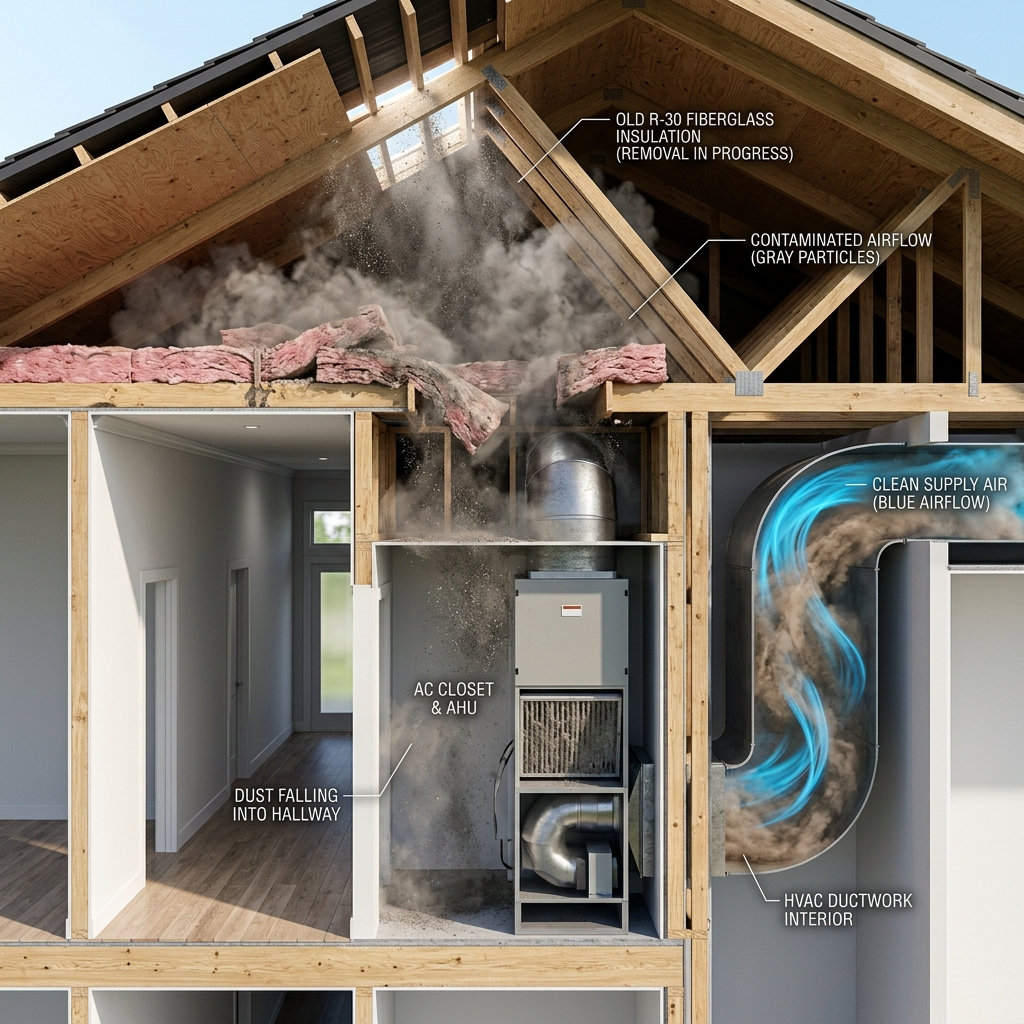
Why Removal Goes Catastrophically Wrong in Florida Homes:
- Gravity Takes Over: Industrial suction hoses or manual bagging tear old fiberglass. Without hermetic containment plastic across the hallway ceiling access hatch, massive clouds of glass micro-fibers fall directly over the AC air handler closet.
- The "Giant Vacuum" Effect: The return plenum beneath your air handler operates under strong negative pressure. If there are microscopic gaps in duct connections or if your return duct is made of worn ductboard, the AC blower violently pulls thousands of cubic feet of insulation dust inside.
- Low-MERV Filter Bypass: Economy fiberglass filters (MERV 1–4) offer zero resistance to sub-micron fibers. The dust passes right through, coating the blower wheel and spraying pressurized glass shards out of every supply vent in the house.
2. The Cellular Science: What Happens to the Human Body?
Inhaling or contacting micro-particles from careless insulation removal is not just a temporary nuisance—it triggers destructive biological cascades at a cellular level.
A. Frustrated Phagocytosis (Severe Lung Damage)
When fiberglass fragments break down, they produce respirable fibers under 3 micrometers (µm) in diameter. These fibers easily bypass the cilia in your nasal passages and trachea, landing deep within the pulmonary alveoli where oxygen exchange occurs.
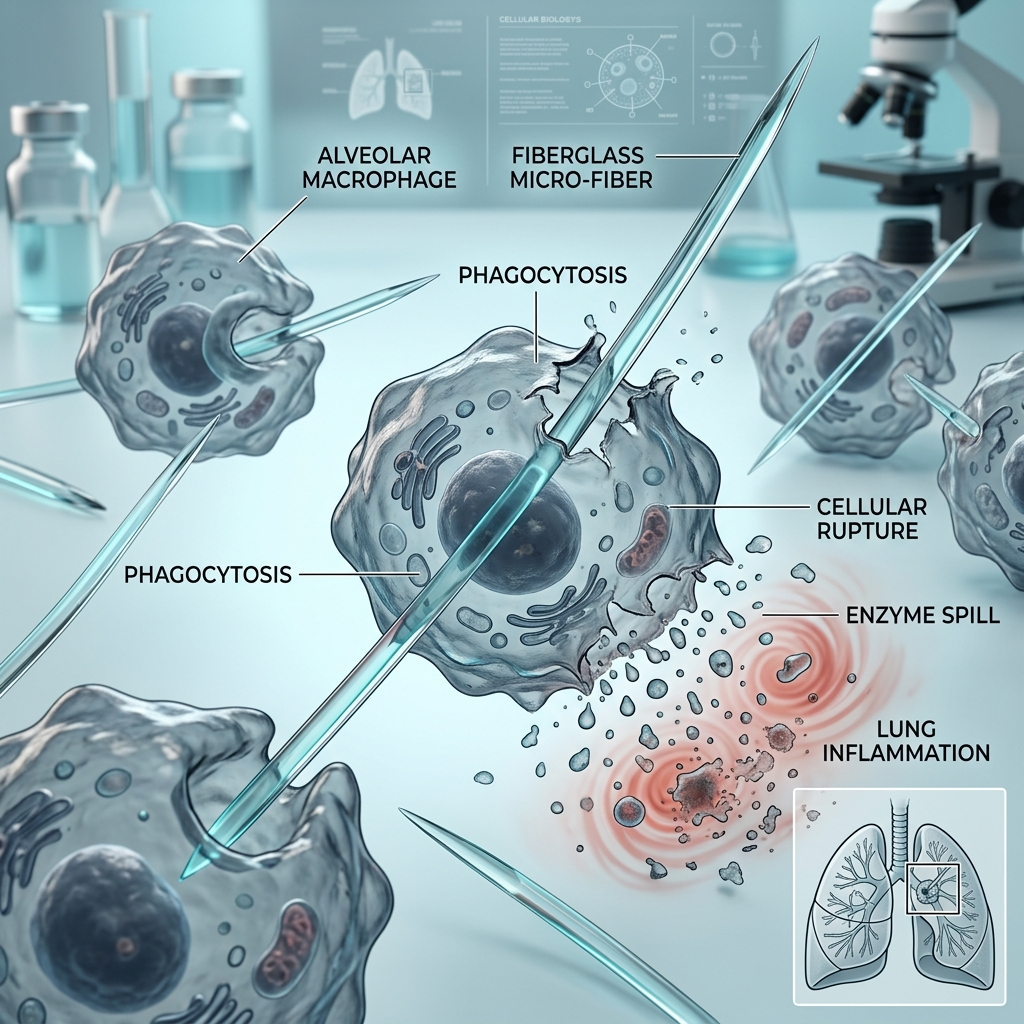
Our body's primary deep-lung defense mechanism is the alveolar macrophage—a specialized immune cell (~13 µm) that patrols alveolar spaces to engulf and digest foreign particles.
When a macrophage attempts to engulf a rigid fiberglass fiber that is longer than the cell itself, it undergoes a toxicological phenomenon known as Frustrated Phagocytosis. Unable to close its membrane around the fiber, the macrophage ruptures, spilling highly destructive digestive enzymes, reactive oxygen species (cellular acids), and inflammatory cytokines directly onto healthy lung tissue.
This perpetual cellular attack maintains chronic airway inflammation. In individuals with asthma, allergies, or COPD, it induces severe bronchospasms. Pulmonologists compare this chronic inflammatory injury to the respiratory damage documented in first responders exposed to complex mineral dust at Ground Zero.
B. Irritative Contact Dermatitis ("Fiberglass Itch")
Coarser fiberglass strands (>5 µm) act like microscopic glass needles. Settling into clothing, bedding, and upholstery, friction forces these shards into the outer skin barrier (the stratum corneum), resulting in intense itching, localized erythema, and painful skin eruptions.
C. The Domino Effect: Breeding a Mold Incubator inside Your AC
Fibers launched into your HVAC ductwork land directly on the wet copper fins of the evaporator coil, which continuously condenses moisture in Florida's humid climate.
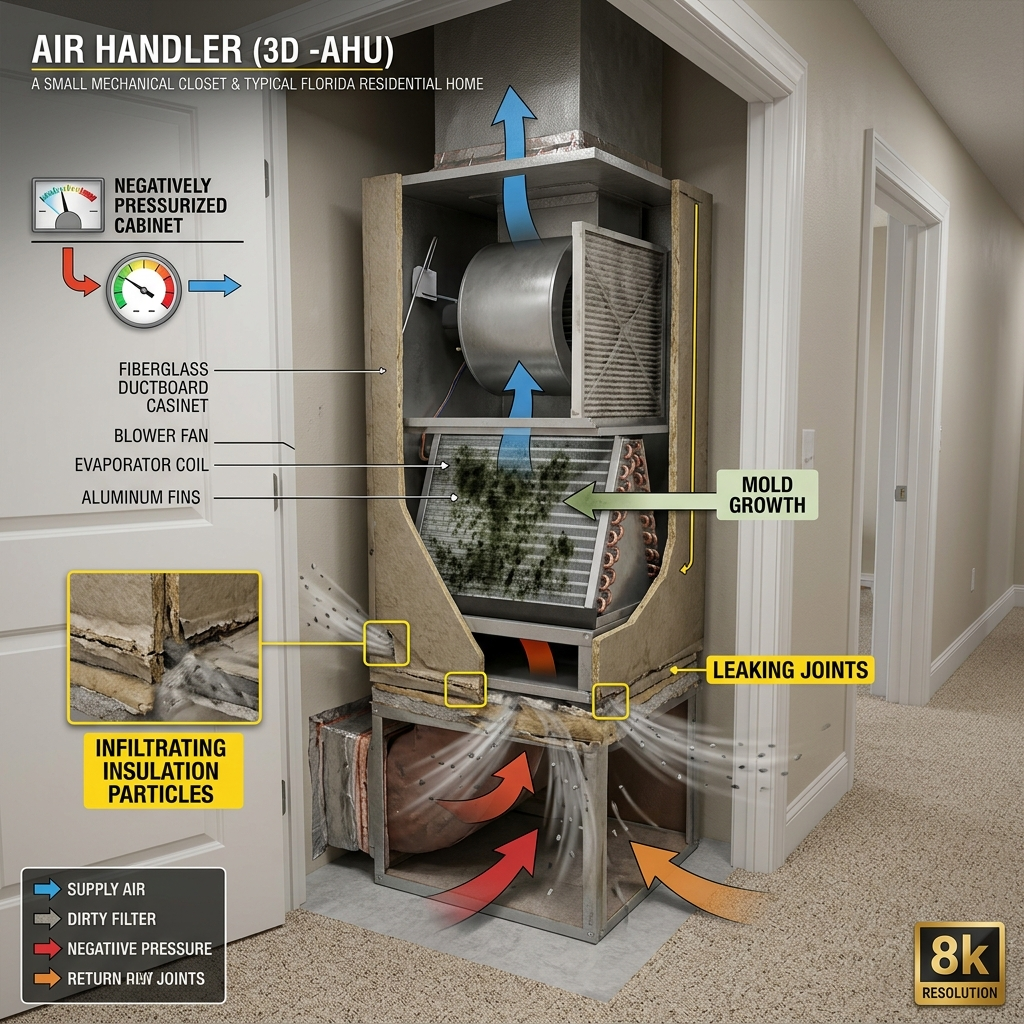
The glass fibers form an intricate web across wet coil fins, trapping organic matter like human skin flakes and pollen. In total darkness and 100% relative humidity, this forms an explosive biological incubator for pathogenic fungi like Alternaria alternata, Aspergillus, and Penicillium.
Within weeks, the mold colony matures, releasing millions of fungal spores, potent mycotoxins, and microbial volatile organic compounds (mVOCs)—the source of that pungent "musty attic odor" blowing into your living spaces.
3. Real South Florida Case Studies
Case Study 1: The Miller Family (West Palm Beach)
The Problem: Persistent Micro-Dust & Hospital Emergency
The Miller family hired a budget insulation crew to remove old fiberglass batts. The workers placed no plastic containment barriers across the hallway ceiling hatch and swept fallen debris around the AC air handler closet with household brooms.
The Consequence: Within days, the family noticed an unremovable film of fine dust across all furniture. Weeks later, everyone developed persistent dry coughing and skin itching. Their 6-year-old son—who had no prior history of severe asthma—was rushed to the emergency room with acute respiratory distress.
The Investigation: A Sani Effect IAQ inspection revealed that the negative pressure of the return plenum had sucked thousands of glass fibers through cracked joints in their ductboard plenum. The cheap MERV 2 filter failed. Micro-fibers embedded into the evaporator coil and blanketed mattress fabrics. The entire HVAC system had turned into a machine blowing invisible glass needles every time the AC cycled on.
Case Study 2: The Chemical Off-Gassing Enigma (Broward County)
Spray Foam Off-Gassing, Asymmetrical Toxicity & Pet Sentinel Alert
A homeowner in Broward County installed spray polyurethane foam (SPF) insulation to seal their roof deck. During installation in extreme attic heat, technicians sprayed the foam too rapidly, causing a chemical stoichiometry imbalance: Component A (Isocyanates) and Component B (Polyols & Amine Catalysts) failed to react in the exact 1:1 ratio.
The Consequence: The foam failed to cure properly, off-gassing a harsh "fishy/chemical" odor. Surprisingly, only the mother became severely ill, while her husband and teenage son felt fine. The mother (who worked from home 20+ hours a day in an upper-floor office) developed severe brain fog, daily migraines, and sudden clinical depression. Simultaneously, the family's 4-year-old Beagle became lethargic, stopped eating, and started vomiting.
The Scientific Explanation:
- Exposure Duration & Biological Sensitivity: The mother spent 20+ hours daily inside the home breathing off-gassed amine catalysts and volatile organic compounds (VOCs). Amine catalysts are known neurotoxins that disrupt central nervous system neurotransmitters, manifesting as severe psychiatric symptoms like unprovoked depression and anxiety.
- Pets as Environmental Sentinels: The dog showed immediate physical toxicity because pets spend 100% of their time indoors with their breathing zone inches from the floor, where heavy VOC gases settle due to thermodynamic density. Its small body mass rapidly overloaded its hepatic detoxification capacity.
4. The Correct Removal Protocol: How to Protect Your Home
Insulation removal is not a basic handyman job; it is a specialized environmental remediation procedure that must follow strict NADCA ACR Standards and building codes:
- HEPA Negative Pressure Containment: Polyethylene plastic containment barriers must isolate the attic access zone. Industrial negative air machines with HEPA filtration (capturing 99.97% of particles down to 0.3 µm) must vent air outward to prevent cross-contamination.
- Non-Abrasive Contact Vacuuming: Ductboard and fiberglass ductwork must never be cleaned with aggressive metal brushes that tear internal linings. NADCA mandates soft-bristle contact vacuuming under continuous negative pressure.
- Thermal Threshold Sealing (FBC R402.2.4): The attic access hatch must be retrofitted with permanent wooden baffles and airtight weatherstripping to physically prevent loose insulation from spilling into the AC closet.
5. Solutions: What to Do If You Are Already Affected
Immediate Steps
- Turn Off the HVAC System: Stop the fan from continuously circulating fibers and chemical fumes through supply vents.
- Get a Licensed IAQ Assessment: Schedule a licensed Florida Mold & Environmental Assessor to perform air and surface sampling for glass fibers and Alternaria spores.
- HEPA Wet-Cleaning: Have an environmental team perform damp HEPA wiping on all hard surfaces and HEPA vacuuming on porous upholstery.
Permanent Solutions
- Replace Severely Contaminated Ducts: The EPA prohibits chemical sanitizers on porous ductboard. Contaminated fiber ductboard must be removed and replaced.
- Install MERV 11 Filtration: Upgrade to pleated MERV 11 filters to capture sub-micron particles without strangling system airflow.
- Germicidal UV-C Irradiation: Install high-intensity UV-C lights inside the air handler to destroy microbial DNA on wet coils.
- Active Dehumidification: Keep indoor relative humidity strictly below 60% to starve mold colonies permanently.
Suspect Contamination from a Recent Attic Project?
Don't let invisible glass fibers or mold spores compromise your family's lungs. Sani Effect specializes in building science audits, HEPA environmental decontamination, and indoor air quality solutions across South Florida.
Or speak directly with our Building Science Engineers: (772) 206-2121