
The Mystery of the "Phantom Vent Mold Ring"
Across Port St. Lucie, Stuart, Palm Beach Gardens, and Boca Raton, one of the most frequent calls our environmental inspection team receives begins like this:
"We have black, soot-like rings growing around our ceiling air vents. I climb on a stepladder every two weeks, scrub the register with bleach or disinfectant, and paint over the drywall. Yet within twenty days, the dark spots break right back through the fresh paint. Is my air conditioner blowing toxic mold directly onto my family?"
The natural instinct is to assume the mold is living inside the ductwork or blowing out of the evaporator coil. But when licensed environmental technicians remove the metal register grille from the ceiling, the real culprit is revealed:
What Technicians Find When Removing the Grille:
The sheet metal or duct-board register boot box sitting in the attic is not sealed to the ceiling drywall. There is an open, unsealed gap—often between 0.5 to 1.5 inches wide—surrounding the boot. The builder or HVAC installer simply slapped a flat metal grille over the drywall hole, leaving an open highway between the blazing, humid attic cavity and your air-conditioned living space.
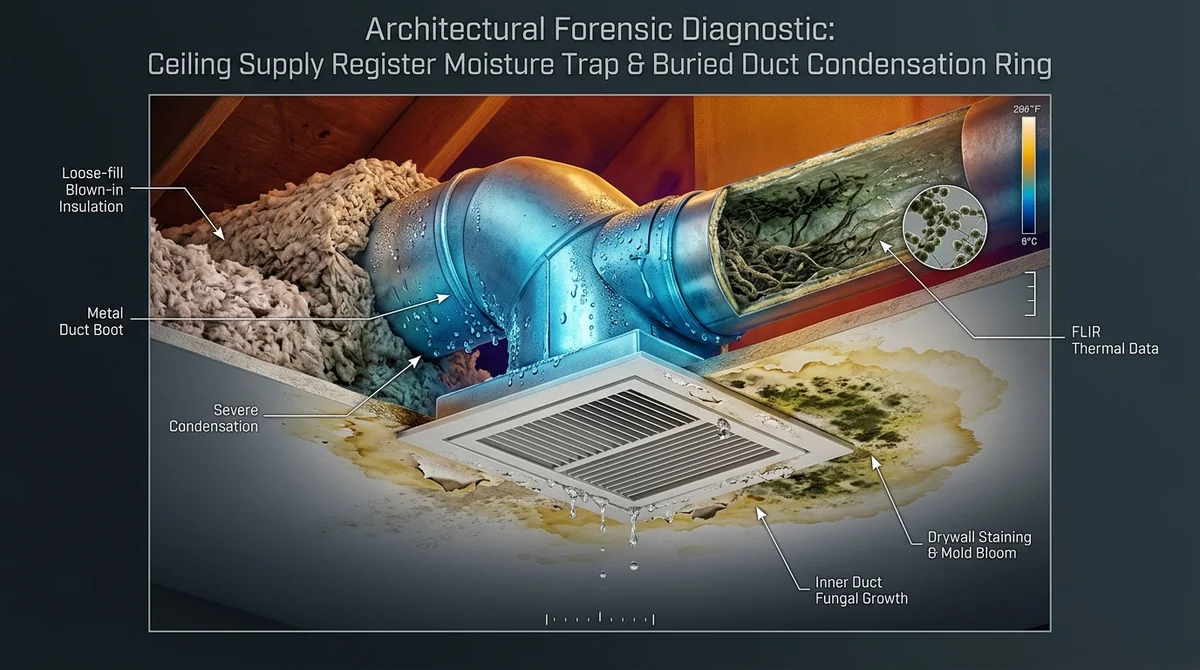
Figure 1: Typical Florida ceiling register exhibiting condensation staining and peripheral mold colonization (*Cladosporium* halo). The mold flourishes precisely where unsealed gaps allow unconditioned attic air to bleed onto the cold drywall edge.
The Collision Zone: Cold Metal Meets Hot Attic Air
To understand why mold grows around ceiling vents and almost never in the middle of a clean ceiling drywall panel, we must look at building physics and the Dew Point Temperature:
Inside Conditioned Supply Air:
- Temperature: 52°F – 55°F conditioned discharge air.
- Metal Register Temp: Chills rapidly to 53°F – 56°F via conductive heat transfer.
- Drywall Edge Temp: Dropping to ~58°F within a 2-inch perimeter around the boot.
Unconditioned Florida Attic Air:
- Attic Temperature: 120°F – 140°F during typical summer days.
- Relative Humidity: 75% – 90% saturated water vapor.
- Dew Point: Often between 68°F and 76°F.
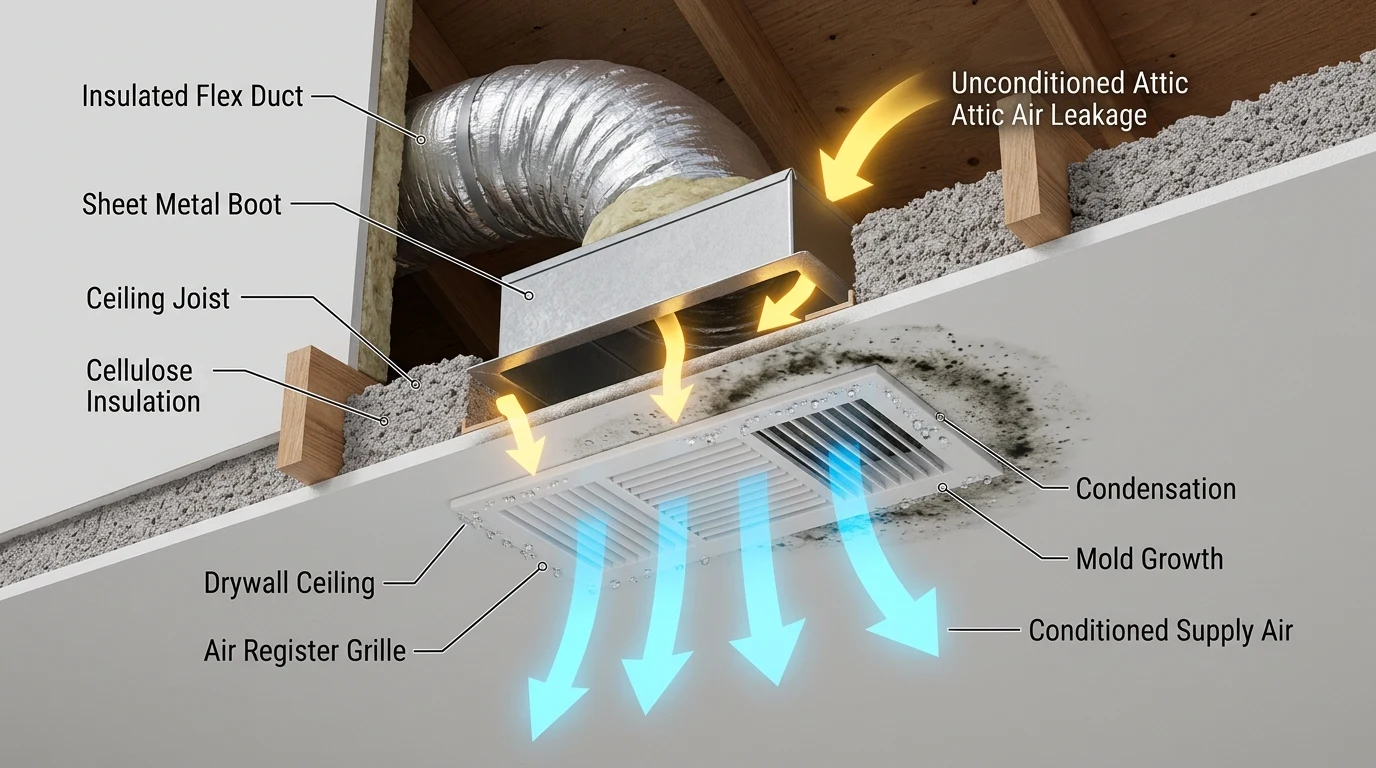
Figure 2: 3D architectural cross-section of an unsealed register boot. When 55°F conditioned air chills the metal register, humid 130°F attic air is siphoned through the rough drywall cut. Because the metal surface is below the 72°F dew point, condensation forms instantly, drenching drywall paper and germinating fungal spores.
The Venturi Siphon Effect Behind the Grille
High-velocity air exiting the directional louvers of an AC supply grille creates a localized low-pressure zone directly behind the flange (Bernoulli’s Principle / Venturi effect). This minor vacuum actively siphons hot, humid attic air through the unsealed rough opening.
The second this moisture-laden attic air touches the 54°F chilled sheet metal or adjacent paper-faced gypsum drywall, it plunges below its dew point. Microscopic water droplets condense continuously while the air conditioning operates. Add cellulose drywall paper (rich in carbon food source) and darkness behind the grille, and fungal colonies—primarily Cladosporium sphaerospermum, Penicillium chrysogenum, and Aspergillus versicolor—establish mature colonization within 48 to 72 hours.
Comparison Matrix: Sealed vs. Unsealed Duct Register Boots
| Engineering Parameter | Unsealed Register Boot (Defective) | Hermetically Sealed Boot (Sani Effect Standard) |
|---|---|---|
| Boot-to-Drywall Interface | Open gap (0.5" - 1.5" raw cut) | Class 1 UL-181 fiber-reinforced mastic seal |
| Attic Air Leakage | Continuous infiltration (5–15 CFM per boot) | Zero CFM bypass (hermetic barrier) |
| Surface Temperature vs. Dew Point | Surface (54°F) sits far below Dew Point (72°F) | No humid attic air touches the chilled metal |
| Condensation Risk | Severe & Chronic (Liquid sweating) | Completely Eliminated (Dry surfaces) |
| Drywall Degradation | Paper rot, chalking gypsum, black mold rings | Drywall remains structurally rigid & clean |
| Airflow Delivery Efficiency | Lost CFM into ceiling cavity; distorted throw | 100% of conditioned air delivered into room |
Whole-House Negative Pressure: The Invisible Vacuum Pulling Attic Toxins
While an unsealed register boot creates a localized condensation ring, a far more dangerous mechanical phenomenon frequently works in tandem: Building Envelope Depressurization (Negative Pressure).
How an Air Conditioner Turns Into a Whole-Home Vacuum:
A typical 4-ton central HVAC system moves approximately 1,600 CFM (Cubic Feet per Minute) of air. If the supply ductwork running through your attic has dislodged seams, torn flex ducts, or unsealed plenums leaking 250 CFM into the unconditioned attic, the HVAC blower is effectively acting as a massive exhaust fan, dumping conditioned air outside the building envelope.
Physics dictates that for every cubic foot of air forced out of your home, an equal cubic foot of air must be pulled in to replace it (Conservation of Mass). In a home with closed windows and doors, the home is placed under continuous negative pressure relative to the attic and outdoors.
Where Does the Starving Vacuum Suck Air From?
The negative pressure turns every unsealed hole, crack, and electrical penetration in your ceiling and exterior walls into an active vacuum suction port:
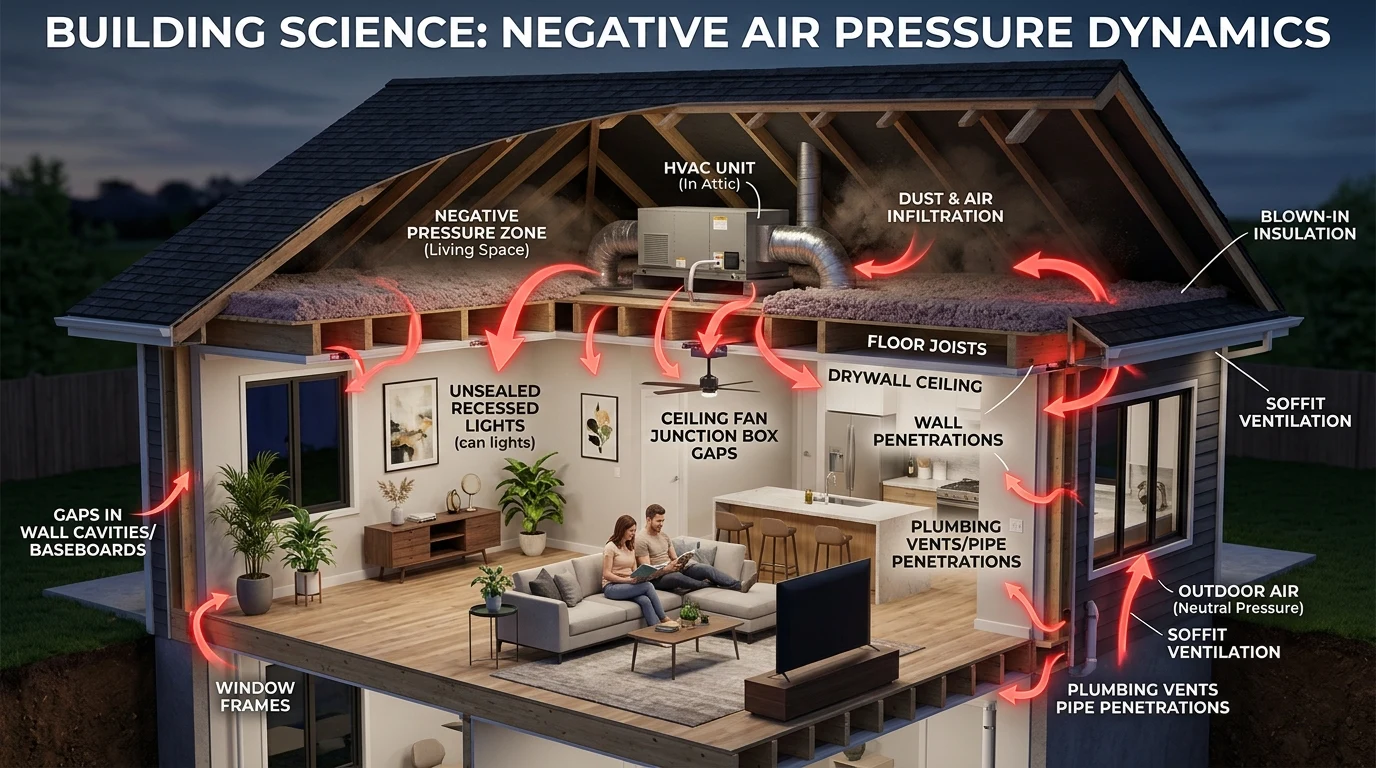
Figure 3: 3D architectural rendering of negative pressure infiltration. A starving HVAC return system creates negative air pressure (suction) inside the living envelope, drawing contaminated 130°F attic air, insulation fibers, and fungal spores down through unsealed can lights, ceiling fans, wall switches, and vanity plumbing chases.
1. Recessed Can Lights & Downlights
Standard recessed lighting housings are Swiss cheese. The uncaulked gaps between the trim ring and drywall act as mini-chimneys dumping warm attic moisture, fiberglass dust, and stale heat directly into living spaces.
2. Wall Outlets & Light Switches
Electricians drill oversized holes through the top plate timber in the attic to run Romex wiring down wall cavities. Under negative pressure, warm attic air is sucked out through wall switch and plug faceplates.
3. Under-Vanity & Cabinet Plumbing Chases
Plumbers routinely saw large 4-to-6-inch jagged openings in drywall for 1.5-inch PVC drain pipes under bathroom vanities and kitchen sinks. These cavities communicate directly with unconditioned wall studs and attic air.
4. Cable, Internet & Electrician Pass-Throughs
Cable technicians, alarm installers, and audio-visual contractors frequently punch unsealed holes through closet ceilings and wall chases, leaving direct unsealed bridges to the attic environment.
Common Negative Pressure Infiltration Pathways
| Penetration Type | How It Communicates with Attic | Primary Pollutants Infiltrated | Permanent Engineering Remedy |
|---|---|---|---|
| AC Ceiling Register Boots | Rough drywall cut wider than sheet metal flange | High humidity, mold spores, drywall condensation | Mastic + backer rod airtight perimeter seal |
| Recessed Can Downlights | Non-airtight fixtures venting through ceiling cutout | Fiberglass fibers, hot humid air, insect debris | Air-sealed fire-rated covers + silicone rim seal |
| Ceiling Fan & Light Boxes | Wire knockout holes in electrical junction boxes | Cellulose dust, rodent dander, hot humid air | Fire-rated expanding foam inside knockout gaps |
| Plumbing Under Vanities | Unsealed drywall cuts around drain & water lines | Musty sewer/attic air, moisture, mycotoxins | High-density elastomeric collars + foam sealing |
| Wall Outlets & Switches | Attic top-plate holes drilled for electrical wiring | Attic particulate matter, fiberglass, ozone/VOCs | Foam top-plate sealing + air-tight foam gaskets |
How Attic Air Intrusion Destroys Family Health
Attic air is the dirtiest, most toxic reservoir of air in any Florida home. It is essentially an industrial zone filled with aged insulation, ambient outdoor heat, roof off-gassing, and biological debris.
When your home operates under negative pressure and unsealed register boots draw this air into the breathing zone, occupants are forced to inhale an unmitigated cocktail of allergens:
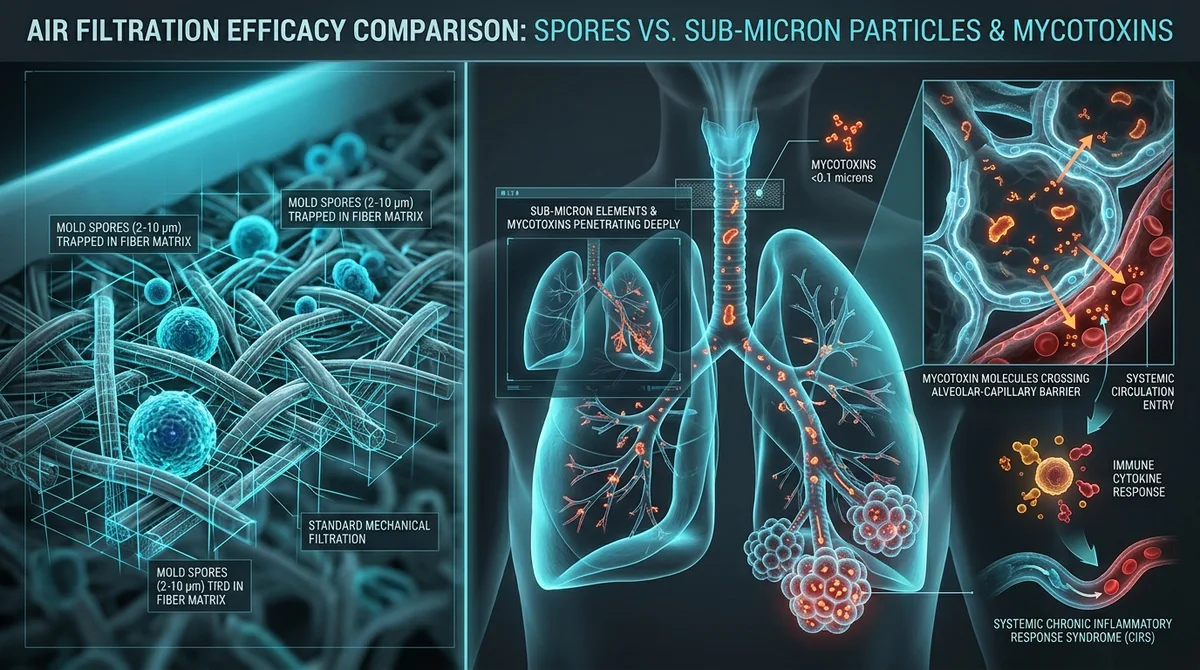
Figure 4: Submicron particulate inhalation. Attic air intrusion pulls fungal spores (< 3 µm), mycotoxins, and respirable glass fibers past the upper airway directly into human alveolar sacs, triggering inflammatory immune cascades.
Common Symptoms Reported:
- Persistent Sore Throat & Hoarseness: Irritation caused by microscopic airborne fiberglass fibers scraping delicate pharyngeal tissues.
- Burning, Watery, Bloodshot Eyes: Chemical and particulate irritation from VOCs and attic dust.
- Chronic Morning Coughing: Lungs attempting to clear trapped fungal spores and particulates inhaled overnight while bedrooms are under negative pressure.
- Sinus Congestion & Headaches: Inflammatory sinusitis triggered by continuous mycotoxin and allergen exposure.
- Unexplained Fatigue: Immune exhaustion from battling continuous submicron biotoxin loads.
The Toxic Infiltration Mix:
- Respirable Fiberglass Particles: Microscopic vitreous fibers that shed from deteriorating attic batts or blown-in insulation.
- Viable Mold Spores: Active spores of Cladosporium, Aspergillus, and Penicillium multiplying on damp roof rafters.
- Rodent & Pest Allergens: Aerosolized dried rodent urine, droppings, and cockroach frass proteins accumulating in attic insulation.
- Off-Gassing Thermal VOCs: Volatile organic compounds baking off shingles, adhesives, and older insulation under 130°F heat.
- Fine Particulates (PM2.5): Ambient South Florida highway and building dust trapped in the attic space.
The Aging Duct Factor: Degraded R-Value Accelerating Condensation
An unsealed register boot is magnified tenfold when paired with aging ductwork. In Florida’s unforgiving attic environment, flexible ductwork and duct board experience severe thermal degradation over 10 to 15 years:
Loss of Thermal Resistance (R-Value Collapse)
Over years of intense attic heat cycles, flexible duct insulation compresses, outer metalized scrim jackets dry out and crack, and internal adhesives dissolve. An original R-6 or R-8 duct can degrade to an effective R-3 or lower. When cold air travels through degraded insulation, the exterior duct jacket drops below dew point and sweats profusely along its entire run—dumping additional water onto ceiling drywall before even reaching the register boot.
*Note: Duct insulation thermal collapse and psychrometric sweating involve specialized engineering considerations. Sani Effect will release a comprehensive educational guide dedicated entirely to aging duct R-value restoration, duct testing, and replacement protocols.
Is Your Home Suffering from Vent Mold & Negative Pressure?
Use this 5-point field checklist to determine if your ceiling vent mold is caused by unsealed boots and attic air intrusion:
The "Ghost Door" Phenomenon
Do bedroom doors slam shut on their own when the AC kicks on, or does it require noticeably more physical effort to open a bedroom door when the central system is running? This is a hallmark sign of severe room-to-room pressure imbalance.
Drafty Can Lights & Outlets
Hold a tissue, incense stick, or thermal sensor under a ceiling recessed can light or wall outlet. If the smoke or tissue pulls inward or flutters vigorously, warm attic air is being vacuumed into your room.
Mold Isolated to the Vent Perimeter
Inspect the ceiling. If the center drywall is bone dry and white, but a distinct dark, fuzzy 1-to-3-inch halo circles the perimeter of the supply register, you have an unsealed boot collision zone.
Morning Respiratory Congestion
Do family members wake up with scratchy throats, stuffed sinuses, or crusty burning eyes that clear up after leaving the house for work or school? This indicates nocturnal exposure to attic particulates.
Persistent Musty "Attic" Odors in Living Areas
Does your home smell like warm wood, dust, or an old attic when the AC cycles, despite the home being clean and sanitized? Attic air is bypassing your mechanical air filters entirely.
How Sani Effect Permanently Eliminates Vent Mold
Spraying bleach or wiping off the metal register does nothing to eliminate the physical conditions creating the moisture. Sani Effect delivers a comprehensive 5-step forensic protocol that repairs the building envelope and permanently stops vent mold:
ANSI/IICRC S520 Drywall Decontamination
We set up HEPA containment, carefully remove grilles, mechanically remediate surface mold hyphae on drywall and boots, and treat substrates with botanical Sani Nano Clean micro-biostatic agents.
Airtight Class 1 UL-181 Boot Mastic Sealing
We bridge all gaps between the sheet metal boot and drywall with closed-cell backer rods and apply thick fiber-reinforced elastomeric mastic. This completely closes the highway between the attic and room.
Digital Manometer Pressure Balancing
Using digital differential pressure gauges, we measure room-to-room pressure and static HVAC balance, identifying duct leaks or return starvation that created the whole-house vacuum.
Building Envelope Penetration Sealing
We air-seal recessed can light fixtures, ceiling fan rough-ins, wire top-plate drill holes, and oversized under-vanity plumbing penetrations with fire-rated expanding sealants.
ActivePure® Submicron Air Purification & Humidity Control
We integrate ActivePure® Advanced Photohydrolysis Technology and dedicated permanent dehumidification (such as the Santa Fe Ultra series) to continuously decontaminate indoor air and stabilize relative humidity below 50% year-round.
Frequently Asked Questions About AC Vent Mold
Stop Wiping Away Vent Mold. Fix the Physical Source.
If dark rings are appearing around your ceiling air conditioning registers, your home is leaking money, energy, and clean air. Contact Sani Effect Environmental for a comprehensive visual mold inspection, boot seal audit, and pressure diagnosis.