
The End of the "Lower Than Outdoors" Loophole
For more than two decades, the microbial remediation industry operated under a subjective rule of thumb: an indoor air sample passed Post-Remediation Verification (PRV) if the total indoor spore count was "statistically lower than the outdoor control sample" and exhibited a similar species distribution.
In South Florida's tropical climate—where outdoor baseline spore counts frequently surge past 5,000 to 25,000+ spores per cubic meter (spores/m³) following rainstorms—this methodology created a dangerous loophole. Contractors routinely passed homes with indoor counts of 1,800 to 3,500 spores/m³, claiming the living space was in "Condition 1" simply because the outdoors was higher.
Why The Historical Method Failed Homeowners:
For sensitized occupants, asthma patients, and individuals suffering from Chronic Inflammatory Response Syndrome (CIRS), 1,500 spores/m³ of aerosolized Aspergillus/Penicillium is a clinical biohazard. Ambient outdoor fungal ecology does not dictate what human lungs can tolerate within an enclosed building envelope.

Figure 1: Advanced Environmental Testing Cleanroom. Illustrating the shift from lenient historical indoor spore baselines to the strict NORMI 2026 Medically-Sound Level 4 Protocol™ (< 500 total spores/m³, < 100 Asp/Pen, and zero target toxigenic species).
Full SizeThe NORMI Medically-Sound Level 4 Protocol™ (Effective Jan 1, 2026)
To protect human health and establish objective clinical clearance metrics, the National Organization of Remediators & Microbial Inspectors (NORMI) published the landmark Medically-Sound Level 4 Protocol™ (Appendix A: Sampling Data Interpretation).
This standard sets unambiguous, numerical thresholds that a residence must achieve before being certified as a healthy, normal fungal environment (Condition 1):
| Sample Category | Laboratory Analytical Metric | NORMI™ 2026 Interpretation | Clinical Benchmark |
|---|---|---|---|
| Mold Air (Non-Viable Cassette) | Total Spore Count per m³ | < 500 spores/m³ | Normal Fungal Ecology |
| Aspergillus / Penicillium | < 100 spores/m³ | Normal Baseline | |
| Target Toxigenic Molds (Stachybotrys, Chaetomium, Trichoderma, Fusarium, Memnoniella) |
NO Target Molds (0) | Zero Tolerance Policy | |
| Surface Tape / Swab (Non-Viable) | Spores Per Microscopic Field | 1 – 10 spores/field | Rare / Normal Settled Dust |
| Surface Swab (Viable Culture) | Colony Forming Units (CFU) | 0 – 30 CFU | Normal Living Space |
| TMVOC (Mold VOC Gases) | Volatile Microbial Compounds (ng/L) | < 8 ng/L | Minimal Metabolic Activity |
| HERTSMI-2 Score | Health Effects Roster of Specific Molds | < 6 Desired (7–10 Acceptable) | Safe for CIRS / Sensitive Patients |
| Bacterial Endotoxins | Endotoxin Concentration (EU/mg) | < 100 EU/mg (Zero Desired) | No Inflammatory Triggers |
| Beta-Glucan | Fungal Cell Wall Biomarkers | Zero Desired | Complete Particle Clearance |
The Core Takeaway for Remediators:
Under the 2026 standard, hitting 800 or 1,200 spores/m³ is no longer acceptable. A home with 600 total spores or 150 Aspergillus/Penicillium fails clearance. To pass, remediators must engineer the dilution ventilation to bring total air volume down beneath the strict 500 spore ceiling.
NORMI™ Medically-Sound Level 4 Protocol™ (Jan 1, 2026)
Original technical guidelines and complete Appendix A sampling data interpretation thresholds.
The Mathematics of Spore Clearance: CFM, ACH & Decay Rates
Reducing airborne spores is governed by physical laws of dilution ventilation and first-order exponential decay kinetics. You cannot "guess" how many days an air scrubber must run. The required run-time is a direct mathematical function of air volume, scrubber capacity, mixing factor, and initial spore load.
1. Air Volume & Air Changes Per Hour (ACH):
First, calculate the contained volume ($V$) in cubic feet:
Next, determine the Air Changes per Hour (ACH) delivered by your HEPA air scrubber:
Example: A 1,500 sq ft home with 9 ft ceilings has 13,500 cu ft. One 1,000 CFM air scrubber delivers (1,000 × 60) / 13,500 = 4.44 ACH.
2. The Exponential Decay Equation:
Under ideal continuous-stirred tank reactor (CSTR) conditions, particulate concentration $C(t)$ over time $t$ decreases according to:
- C0: Initial spore count (e.g. 1,800 spores/m³).
- η: Single-pass HEPA filter efficiency (99.97% = 0.9997).
- m: Real-world room mixing factor (typically 0.70 to 0.85).
- t: Scrubbing run-time in hours.
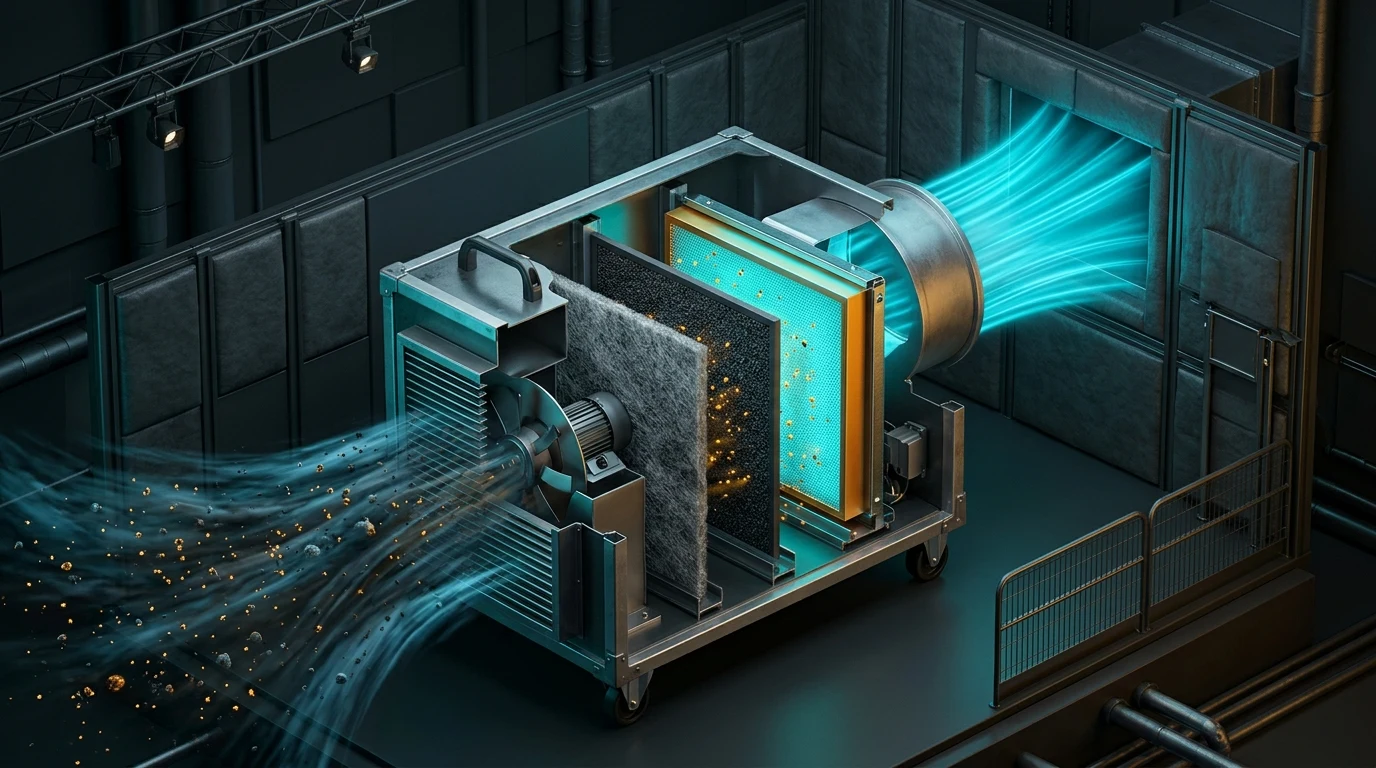
Figure 2: Internal Mechanics of a 1,000 CFM HEPA Air Scrubber. 3-stage filtration: pre-filter captures coarse drywall dust, activated carbon adsorbs TMVOC gases, and certified 99.97% DOP HEPA media captures submicron fungal spores and fragments.
Full SizeSpore Reduction Run-Time Reference Table (1,500 sq ft Baseline)
The table below illustrates the real-world operational run-times required to drop various initial indoor spore concentrations down to the new Condition 1 threshold (< 500 spores/m³) in a standard 1,500 sq ft home (13,500 cu ft volume).
| Initial Spores/m³ | Target Clearance | % Reduction | 1,000 CFM Scrubber (4.4 ACH) | 2,000 CFM Dual Scrubbers (8.8 ACH) |
|---|---|---|---|---|
| 800 spores/m³ | < 500 | 37.5% | 48 Hours (2.0 Days) | 40 Hours (1.7 Days) |
| 1,200 spores/m³ | < 500 | 58.3% | 60 Hours (2.5 Days) | 46 Hours (1.9 Days) |
| 1,400 spores/m³ | < 500 | 64.3% | 72 Hours (3.0 Days) | 50 Hours (2.1 Days) |
| 1,800 spores/m³ | < 500 | 72.2% | 96 Hours (4.0 Days) | 52 Hours (2.2 Days) |
| 2,500 spores/m³ | < 500 | 80.0% | 120 Hours (5.0 Days) | 60 Hours (2.5 Days) |
| 5,000 spores/m³ | < 500 | 90.0% | 144 Hours (6.0 Days) | 68 Hours (2.8 Days) |
| 10,000+ spores/m³ | < 500 | 95.0%+ | 168+ Hours (7.0+ Days) | 78 Hours (3.25 Days) |
The Scientific Paradox: Why Textbook Math Says "26 Minutes" but Field Physics Demands 72 to 96 Hours (3 to 4 Days)
Every certified remediator and building scientist encounters this common conundrum: if you input 2,000 spores/m³ and a 1,000 CFM air scrubber into a standard laboratory dilution equation ($C(t) = C_0 \cdot e^{-k t}$), the purely mathematical result claims an enclosed 1,500 sq ft room reaches Condition 1 in just 26 to 45 minutes. Yet, anyone who shuts off an air scrubber after 2 hours will fail post-remediation verification (PRV) testing 100% of the time. In the real world, reducing 1,600 to 2,000 spores/m³ down to NORMI Level 4 clearance reliably takes 72 to 96 continuous hours (3 to 4 days). Why?
1. Gravitational Settling (Stokes' Law)
Fungal spores (*Aspergillus/Penicillium* at 2–5 µm, *Cladosporium* at 5–15 µm) do not stay suspended forever. By Stokes' Law, they settle gravitationally onto floors, trim, baseboards, and furnishings at settling velocities between 0.05 and 0.3 cm/second. Air scrubbers only capture suspended airborne particles; spores resting on surfaces are completely immune to scrubber suction until physically agitated.
2. Continuous Aerosol Re-Entrainment
As HVAC cycles switch, doors swing, or technicians walk across subfloors, settled spores are continuously resuspended into the airstream in successive waves (*aerosol re-entrainment*). This creates an ongoing secondary internal generation rate that pure textbook equations ignore. It takes hundreds of complete volumetric air cycles over several days to exhaust this resuspension reservoir.
3. Non-Ideal Mixing & Dead Air Zones ($m = 0.20 - 0.35$)
Textbook formulas assume an empty, frictionless room with perfect instantaneous mixing ($m = 1.0$). Real residential architecture features walk-in closets, perimeter corners, coffered ceilings, and furniture shadows where air velocity drops beneath 25 FPM (feet per minute). Instead of 1.0, real residential mixing factors hover between 0.20 and 0.35, multiplying required scrubbing duration by 3x to 4x.
4. Post-Remediation Verification (PRV) Stability
Running 1,000 CFM for 72 to 96 hours (3 to 4 days) combined with a full "HEPA Sandwich" (contact vacuuming + antimicrobial wipe-down + continuous multi-day negative air) ensures the particulate mass in both the air column and boundary surfaces reaches true, permanent thermodynamic equilibrium below 500 total spores/m³ and 100 Asp/Pen.
Critical Field Reality: Settled Spores & Re-entrainment:
Running an air scrubber alone without touching surfaces will never achieve clearance. Over 90% of spores settle out of the air onto floors, baseboards, and furniture within hours. If technicians do not perform HEPA contact vacuuming and damp antimicrobial wiping of all horizontal surfaces, occupants walking across carpets will immediately kick millions of settled spores back into the air, resetting the concentration.

Figure 3: Dilution Ventilation Kinetics. Illustrating the exponential drop in airborne spore concentration over time as air changes per hour (ACH) cycle room volume through certified 99.97% HEPA filtration media.
Full SizeAir Scrubber Run-Time & Spore Clearance Calculator
Adjust your home's square footage, initial laboratory spore count, and scrubber CFM to dynamically calculate required Air Changes per Hour (ACH) and total days to achieve 2026 Condition 1 Clearance (<500 spores/m³).
4.44 ACH meets the minimum standard. To accelerate clearance for sensitive occupants, increase airflow to 8+ ACH by adding a second unit. Mandatory HEPA sandwich vacuuming is required on Day 1.
The Sani Effect Protocol: Achieving 100% Guaranteed Clearance
At Sani Effect Environmental, our certified Florida mold remediators (#MRSR4448) execute a systematic, forensic engineering protocol designed specifically to meet and exceed the 2026 NORMI Level 4 Medically-Sound Standard:
Containment & Negative Air
6-mil poly barriers and negative air pressure (-5 Pa) prevent cross-contamination into clean zones.
HEPA Sandwich Cleaning
Contact vacuuming, EPA botanical damp wipe, followed by secondary HEPA vacuuming of all surfaces.
Continuous HEPA Scrubbing
Continuous operation of 1,000–2,000 CFM units providing 8–12 ACH until air reaches <500 spores/m³.
ActivePure® Molecular Stabilization
24/7 sub-microscopic hydroperoxides neutralize residual pathogens on all surfaces permanently.
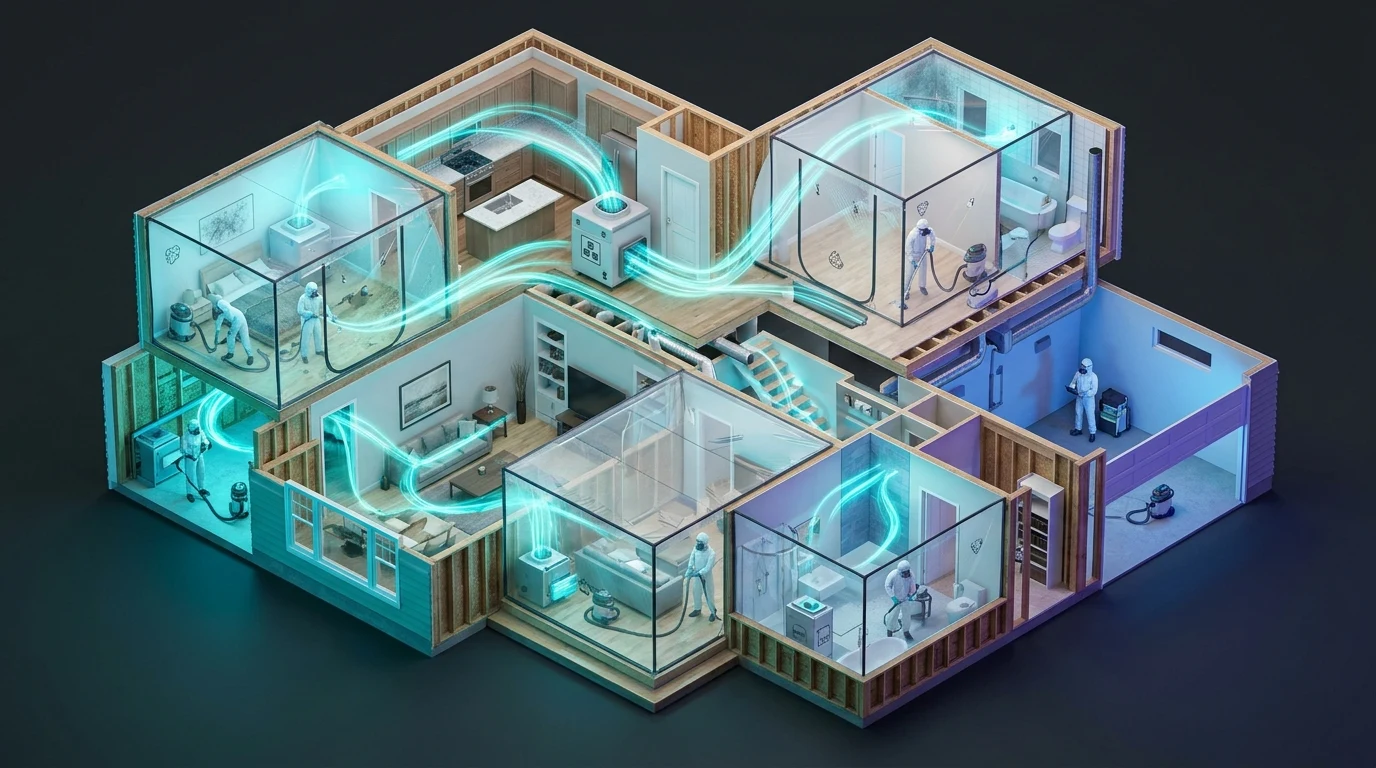
Figure 4: Whole-Home Condition 1 Containment Architecture. Demonstrating negative-pressure isolation, multi-stage HEPA air scrubbers, certified technician surface vacuuming, and laminar air circulation across living spaces.
Full SizeFrequently Asked Questions: Spore Clearance & Air Scrubbing
Need Guaranteed Condition 1 Clearance for Your Property?
Whether preparing a home for real estate transaction closing, protecting medically sensitive family members, or resolving severe water intrusion, trust Sani Effect Environmental across Martin, St. Lucie, and Palm Beach Counties.