
In Florida residential architecture, homeowners are frequently told that adding thicker attic insulation is the ultimate investment for lower energy bills. However, in low-pitch roof homes where central air handlers are housed inside interior living-room or hallway closets, over-insulating an attic can trigger a catastrophic indoor air quality failure.
When blown loose-fill insulation (R-32 to R-38+) is installed without regard for building physics, it frequently spills over the top wall plates, physically choking the exterior soffit intake vents. This suffocates the attic's natural breathing cycle, trapping superheated humidity inside a low-clearance cavity. When cold air ducts are compressed down into or buried directly under this suffocating blanket, extreme thermal condensation erupts—bleeding through ceiling drywall, destroying paint, and colonizing every supply vent with toxic mold.
1. The Layout: Interior Closet HVAC & Low-Pitch Attic Geometry
Throughout Florida, tens of thousands of single-family ranch homes and suburban properties utilize an architectural layout where the central HVAC air handler is installed inside a vertical interior closet—such as a hallway louvered utility closet or dedicated mechanical closet—while the duct distribution network is routed through a shallow attic above:
Interior Closet Air Handler
The blower unit draws conditioned return air from the living space and pushes cold supply air (52°F to 55°F) vertically up into a main supply trunk that penetrates the ceiling into the attic.
Low-Pitch Roof Clearance
A shallow roof pitch (3:12 or 4:12) means vertical clearance near the roof edges drops to under 18–24 inches. There is virtually no headspace to suspend ducts high above the ceiling floor.
2. The Suffocated Attic: When R-32+ Insulation Blocks Soffit Vents
A functional residential roof depends on the passive stack ventilation principle: fresh, cooler air must enter through open perimeter soffit vents along the home's eaves, sweep across the attic underside, and exit through ridge vents or off-ridge roof caps.
When insulation contractors or weatherization programs blow deep loose-fill fiberglass or cellulose (often 12 to 16+ inches deep to reach high R-values) into a low-clearance attic without installing rigid rafter baffles (*AccuVent / Raft-R-Mate*), the insulation spills directly into the eaves. This creates an impermeable insulation dam that completely blocks the soffit intake vents:
The Stagnant Heat & Humidity Trap
Without perimeter airflow intake, the attic cannot breathe. Solar radiant heat bakes the roof sheathing, superheating the trapped attic air to 130°F–140°F with relative humidity levels exceeding 85% to 90%. The ambient dew point inside this unventilated roof cavity climbs past 78°F–82°F.
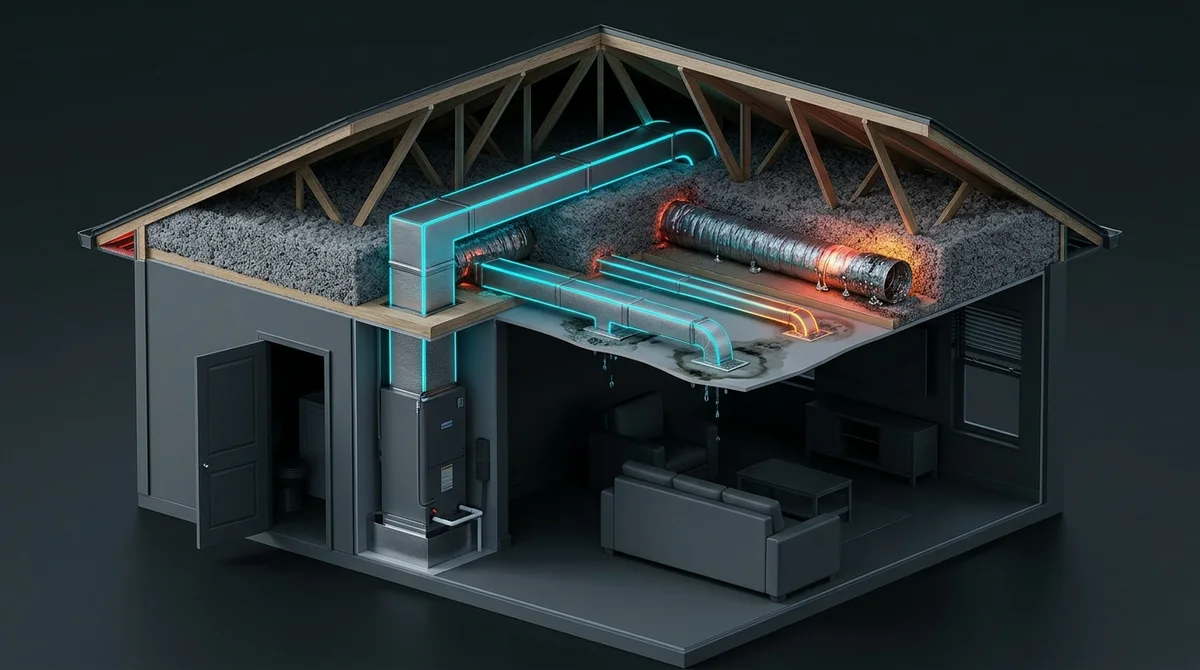 Forensic Architectural Cutaway: Closet HVAC air handler pushing cold air into a low-clearance attic. Deep R-32+ insulation chokes perimeter soffit vents, suffocating ventilation and forcing buried ducts to sweat profusely against ceiling drywall.
3. The "Buried Duct" Thermal Trap & Ceiling Drywall Damage
Because of the low ceiling clearance, flexible ducts cannot be properly suspended in the air. Instead, they are laid directly on the attic floor and buried beneath or pushed tightly against the thick insulation layer. This creates a severe thermal condensation sandwich:
1. Thermal Bridging on the Outer Jacket
The flexible duct carries 52°F chilled air. Where the cold duct exterior touches the saturated 85% RH air trapped inside the insulation blanket, the outer vapor barrier falls drastically below the dew point, causing sustained liquid sweating across the entire duct run.
2. Pooling at the Register Boot Cans
Condensed water trickles downhill along the flexible duct outer jacket toward the lowest mechanical point: the sheet-metal ceiling register boot cans. Water accumulates directly on the top surface of the drywall ceiling surrounding each supply grill.
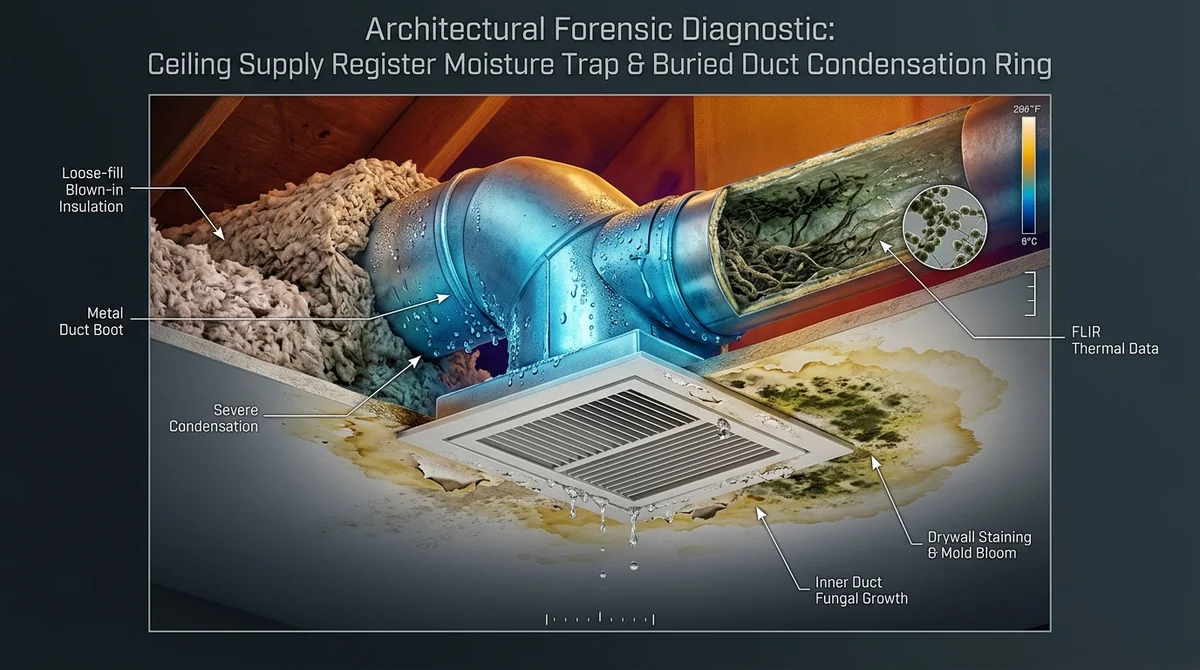 Forensic Diagnostic Detail: Moisture pooling around the unsealed ceiling register boot can. Sustained condensation bleeds through the gypsum core, blistering paint and colonizing concentric rings of toxic mold around the supply vent.
As liquid water continuously saturates the gypsum board around the AC vents, the organic cellulose paper of the drywall achieves water activity aw ≥ 0.70. Within days, concentric rings of black and dark-olive mold bloom around the perimeter of the ceiling grills. Paint blisters, drywall sags, and the joint compound degrades into a soft, crumbling paste.
4. Active Mold Colonization Throughout the Entire Duct Network
The damage is not confined to the exterior drywall. Because the unvented attic maintains elevated indoor relative humidity (often 68% to 78% RH inside the home), the cold metal registers and interior fiberglass liners remain wet during the HVAC off-cycle:
Fungal hyphae colonize the interior fiberglass insulation of the duct boots and propagate backward through the trunk lines. The entire HVAC distribution network becomes a contaminated biological incubator. Every time the closet air handler fan activates, it acts as an aerosol gun, blasting fungal conidia, microbial volatile organic compounds (mVOCs), and microscopic allergens directly into every bedroom and living area.
5. Active Fungal Species & Severe Health Hazards for Occupants
Forensic tape-lift and air cassette testing in homes suffering from buried duct condensation consistently identify three virulent mold taxa actively degrading occupant health:
Cladosporium sphaerospermum
Forms the dense, olive-black velvety colonies encrusting metal grills and drywall edges where cold air meets warm room moisture.
Symptoms: Severe allergic rhinitis, ocular burning, skin rashes, and chronic coughing.Aspergillus niger & versicolor
Flourishes deep inside saturated drywall gypsum paper and unsealed duct boots. Produces toxic sterigmatocystin mycotoxins.
Symptoms: Asthma exacerbation, fungal sinus infections, persistent bronchitis, and CIRS inflammation.Penicillium chrysogenum
Multiplies rapidly across dusty fiberglass liners. Releases massive clouds of sub-micron cellular fragments during blower startups.
Symptoms: Chronic morning headaches, cognitive brain fog, unexplained fatigue, and upper airway congestion.6. The Sani Effect Corrective Protocol: Restoring Airflow & Eliminating Mold
Wiping the ceiling with bleach or merely replacing a flexible duct is a guaranteed waste of money if the attic physics remain broken. Sani Effect Environmental executes an engineered 5-step corrective strategy:
| Phase | Target Area | Corrective Engineering Action |
|---|---|---|
| 1 Soffit Clearing | Roof Eaves & Baffles | Rake back over-blown R-32+ insulation from all exterior eaves and install rigid rafter baffles (*AccuVent*) to restore 100% unimpeded perimeter intake airflow. |
| 2 Duct Elevation | Attic Duct Network | Elevate all buried ducts off the ceiling floor using 1.5-inch non-pinching suspension webbing, creating a mandatory 2-to-3-inch air gap between duct jackets and insulation. |
| 3 Boot Air-Sealing | Ceiling Register Boots | Mastic-seal the gaps between metal boot cans and ceiling drywall from the attic side, preventing conditioned cold air from short-circuiting and condensing. |
| 4 Remediation | Ceiling Drywall & Ducts | Surgically extract mold-damaged drywall collars under HEPA negative air containment; perform electrostatic botanical disinfection and Sani Coat fungistatic encapsulation of duct interiors. |
| 5 Active Protection | Closet HVAC & IAQ | Install dedicated dehumidification maintaining 45%–50% RH, and mount the Sani Duct Guardian with ActivePure® Advanced Photohydrolysis Technology directly into the closet air handler plenum. |
Authoritative Engineering References
This technical analysis synthesizes consensus standards from leading authorities on attic ventilation, buried duct thermal performance, and biological remediation:
Lstiburek, J. (Building Science Press). Buried and Encapsulated Ducts in Humid Climates. Analyzes condensation risks when duct outer jacket vapor barriers are buried under loose-fill insulation in unconditioned hot-humid attics.
Building America Solution Center. Attic Ventilation, Eave Baffles & Duct Clearance Standards. Mandates unobstructed net free ventilating area (NFVA) across soffits to prevent interstitial condensation.
National Air Duct Cleaners Association. Assessment, Cleaning, and Restoration of HVAC Systems. Section 3.2: Directives on microbial amplification inside condensation-compromised residential ductwork.
Institute of Inspection Cleaning and Restoration Certification. Standard for Professional Mold Remediation. Protocols for structural drywall extraction, negative pressure containment, and PRV testing.
Notice Dark Rings or Water Stains Around Your AC Vents?
Do not let buried ducts and suffocated attic ventilation compromise your family's health or ceiling stability. Schedule an immediate forensic inspection with thermal moisture mapping and certified laboratory analysis.