
During routine attic inspections across Palm Beach County and the Treasure Coast, our environmental forensic teams frequently encounter a silent, compounding crisis: air conditioning units resting inside severely corroded secondary drain pans, surrounded by chunks of loose spray foam insulation, discarded drywall screws, and foul-smelling slime.
Most homeowners believe that because their attic is sealed with modern spray foam insulation, their indoor environmental quality is protected from Florida’s brutal ambient humidity. In reality, when an HVAC condensation failure occurs inside an encapsulated attic, the building physics invert. Stagnant moisture cannot evaporate to the outside. Instead, it transforms your emergency drain pan into an incubator for bacterial biofilms, airborne fungal spores, and structural ceiling decay.
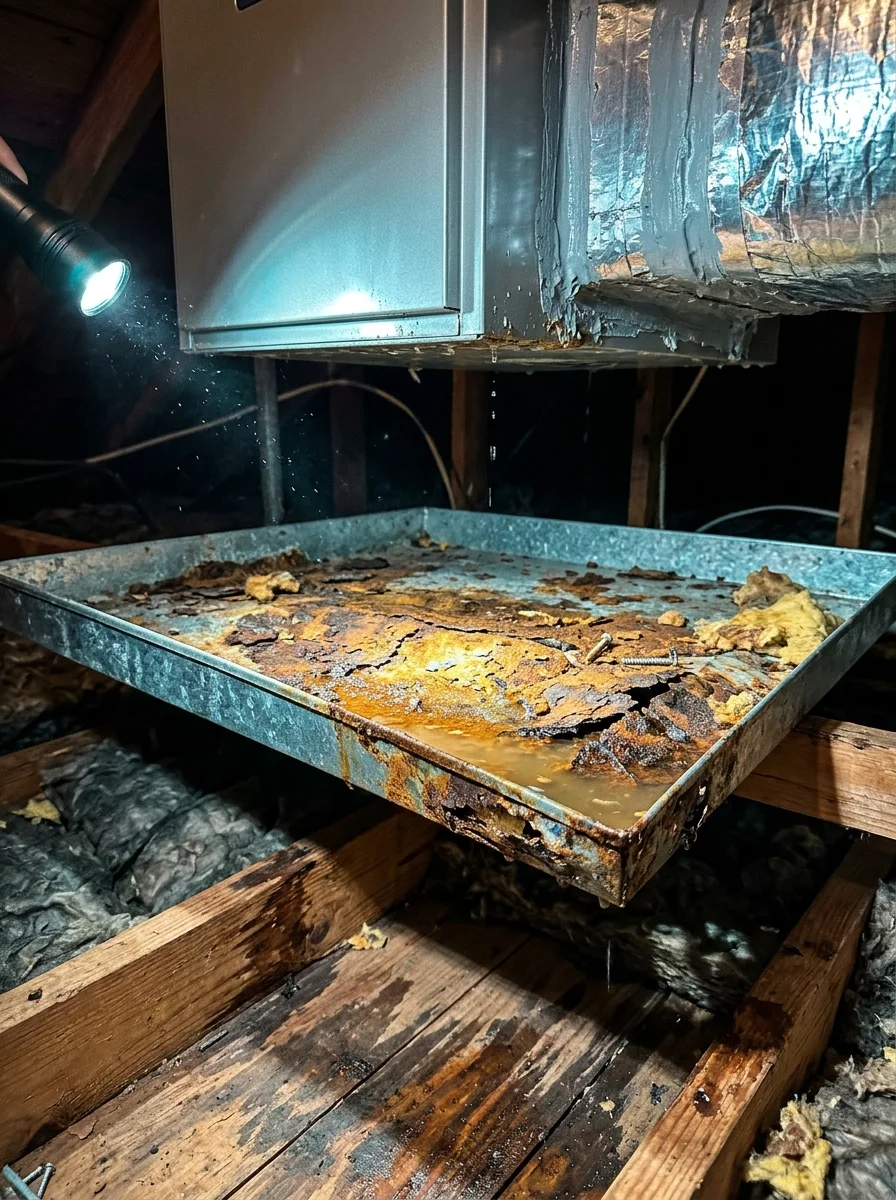
Field Analysis: What This Case Reveals
Under-cabinet forensic diagnostic evaluation highlights four compounding building physics failures threatening air quality and structural stability:
Deep brown scaling proves chronic standing water recurring over weeks or months.
Loose spray foam chunks act like sponges, holding moisture and feeding microbes.
Discarded metal screws cause localized galvanic reactions and premature pan pitting.
Unsealed plenum seams pull musty attic air directly into supply ducts to bedrooms.
1. Rust Is a Symptom of Chronic Standing Water (Not an Accident)
Central air conditioning air handlers in Florida remove gallons of moisture from your home’s indoor air every single day. This condensate collects on the indoor evaporator coil and flows through an internal primary drain line into your household plumbing or outdoor discharge.
The large galvanized metal tray located beneath the air handler is a secondary emergency drain pan. According to the Florida Building Code (Mechanical, Section 307.2.3), this pan exists solely as a fail-safe to catch water in the event of an unexpected blockage or coil freeze-up. Under normal operating conditions, this pan should remain bone dry 365 days a year.
The Meaning of Rust
Galvanized sheet metal is coated with a protective layer of zinc specifically to prevent oxidation. For deep, flaking rust to form, that zinc barrier must be dissolved by prolonged submersion in acidic, microbial standing water over weeks or months. This is incontrovertible physical proof of chronic drainage failure.
The Debris Sponge Factor
When insulation contractors spray open-cell or closed-cell polyurethane foam, trimmings and dust fall into open equipment pans. Foam chunks act like synthetic sponges, absorbing stagnant moisture, preventing natural evaporation, and keeping the galvanized metal continuously soaked.
2. Proliferation of Bacterial Biofilm, Mold Spores & "Dirty Sock Syndrome"
Stagnant condensate water inside a warm attic pan does not stay sterile for long. As ambient household dust, pollen, and microscopic skin cells settle into the pan, they mix with the standing water to create a thick, gelatinous layer known as a microbial biofilm.
What Is "Dirty Sock Syndrome"?
When aerobic and anaerobic bacteria feed on the organic matrix of dust and spray foam debris in a warm, unevaporated drain pan, their metabolic process off-gasses volatile sulfur compounds, amines, and Microbial Volatile Organic Compounds (MVOCs). This produces the sharp, nauseating stench commonly called "Dirty Sock Syndrome"—a telltale sign of biological contamination in the HVAC system.
Alongside bacterial colonization, constant standing moisture creates an ideal microclimate for opportunistic fungal amplification. Fungal species such as Aspergillus niger, Penicillium, and Cladosporium thrive in these damp, dark metal crevices, producing millions of microscopic airborne spores that actively search for new cellulose surfaces to colonize.
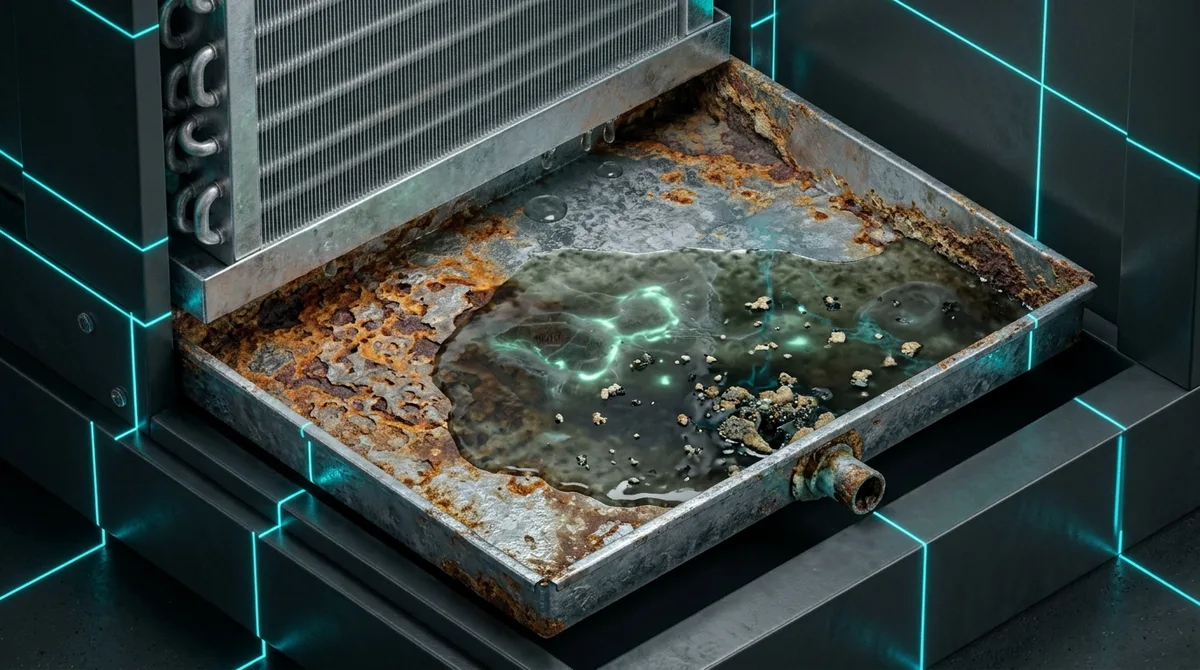 Scientific 3D Visualization: Bacterial biofilm synthesis and microbial amplification over corroded galvanized steel.
3. The Sealed Spray Foam Trap: Pressure & Infiltration Dynamics
Having your attic encapsulated with spray foam fundamentally alters the thermodynamics and airflow mechanics of your entire home. Understanding this difference is critical:
Natural Convective Exhaust
Traditional attics have soffit and ridge vents that continuously circulate outdoor air across the roof rafters. If an AC pan develops mild odor or moisture, convective air movement naturally vents much of those fumes harmlessly out through the roof ridge.
Zero Atmospheric Venting
Spray foam seals all exterior vents, bringing the attic inside the thermal envelope of the building. The attic becomes a sealed, semi-conditioned pressure vessel. Any odor, bacteria, or mold spores generated in this space have nowhere to escape and concentrate in the attic air volume.
The Negative Pressure Suction Effect
The most dangerous aspect of this dynamic is mechanical suction. Your attic air handler contains a high-powered blower wheel that pulls air through return ducts under intense negative pressure (often -25 to -75 Pascals).
In real-world installations, cabinet seams, plenum connections, and aging foil tape (as visible peeling back in our forensic photo) develop micro-gaps. The blower wheel acts like a high-powered vacuum, pulling the contaminated, biofilm-laden attic air directly through these unsealed seams into the primary airflow. The result? Your air conditioner distributes concentrated bacterial MVOCs and mold spores directly into your bedrooms, nursery, and living spaces every hour of the day.
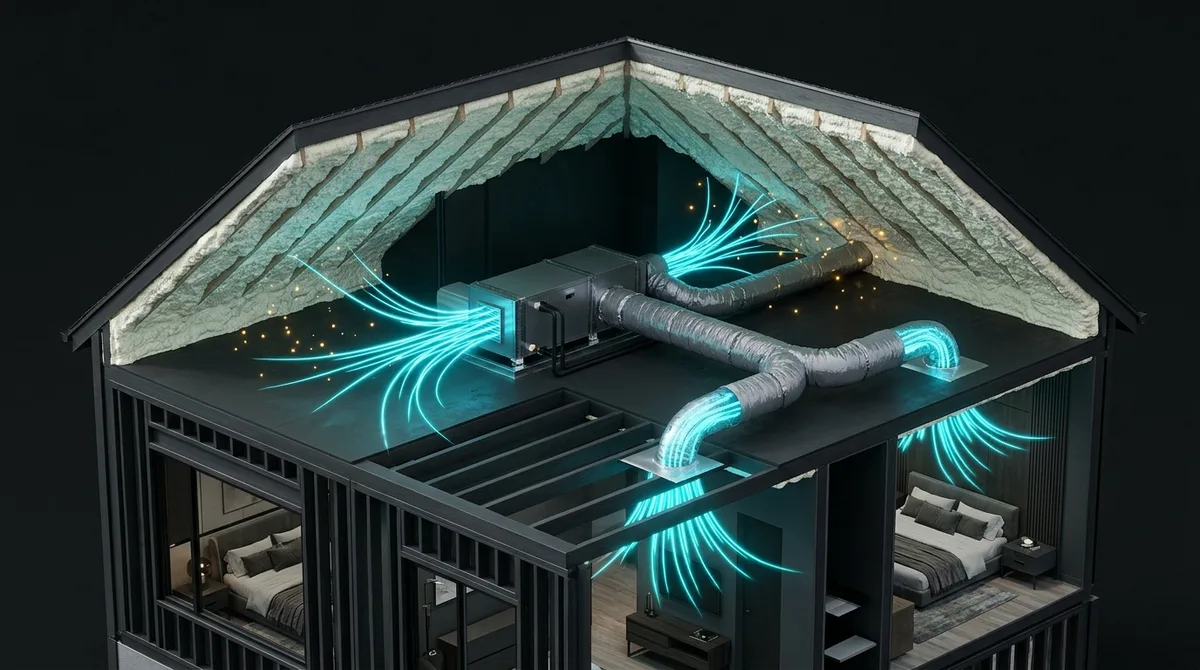 Architectural Physics: Negative pressure airflow pulls unvented attic air through unsealed cabinet seams directly into living areas.
4. Structural Hazard: Pinhole Perforation & Ceiling Collapse
Beyond severe biological contamination, a rusted drain pan represents an immediate structural threat to your property. Galvanized sheet metal is thin—typically between 24 and 26 gauge (0.021 to 0.027 inches thick).
The Progression of Pinhole Perforation:
- Phase 1 (Zinc Depletion): Acidic standing water dissolves the sacrificial zinc galvanization, exposing bare steel.
- Phase 2 (Pitting Corrosion): Localized oxidation eats inward, forming microscopic pinholes along the bottom creases and corners.
- Phase 3 (Bypass Leakage): When a full condensate overflow occurs, water does not reach the elevated secondary PVC safety pipe or trigger the float switch. Instead, it drips continuously through the perforated metal floor.
- Phase 4 (Ceiling Collapse): Water saturates ceiling joists and drywall gypsum board directly beneath the unit. Overloaded with water weight, the saturated drywall suddenly shears and collapses into the finished living spaces below.
Florida Insurance Reality: Denied Water Claims
Florida homeowner insurance policies strictly distinguish between sudden, accidental pipe bursts and "gradual, ongoing seepage or leakage over 14 days."
When an insurance adjuster investigates ceiling water damage and inspects the attic, the presence of heavy rust, scaling, and debris inside the drain pan serves as definitive forensic evidence that moisture was neglected over a long period. In many cases, insurance carriers will deny the entire water mitigation and mold remediation claim based on long-term wear and tear exclusions.
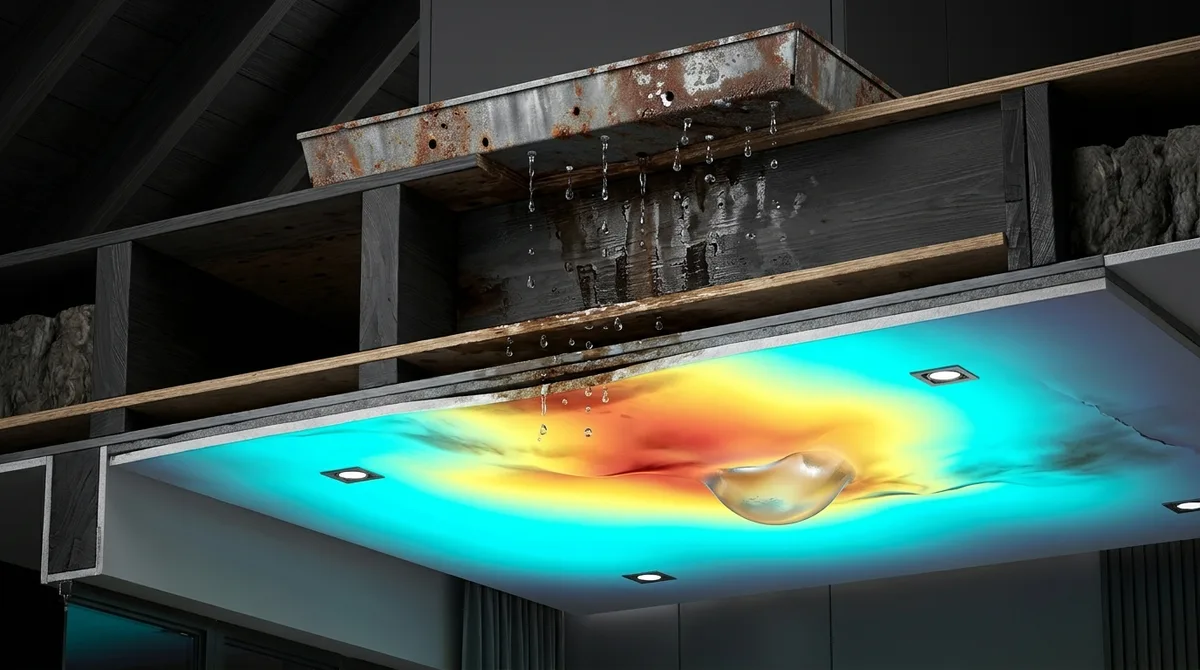 Structural Cutaway: Pinhole leaks saturate wood joists and cause catastrophic drywall ceiling sagging and collapse.
5. The Sani Effect Protocol: Engineered Restoration & Permanent Protection
Solving a rusted drain pan inside a spray foam attic requires an integrated environmental and mechanical protocol. Sani Effect Environmental executes a comprehensive 5-step restoration standard:
Diagnostic Moisture & Pitch Audit
We evaluate the slope, P-trap depth, and flow velocity of both the primary and secondary condensate lines using calibrated digital levels and infrared thermography to identify why water pooled initially.
Debris Extraction & Biofilm Sanitization
All loose spray foam fragments, degraded fasteners, and sediment are HEPA-vacuumed. The pan and surrounding framing are decontaminated with hospital-grade, EPA-registered botanical antimicrobials.
Pan Replacement or Elastomeric Sealing
Corroded metal pans are either replaced with heavy-duty corrosion-proof ABS composite pans or lined with an industrial seamless elastomeric polymer barrier that completely isolates the metal from moisture.
Plenum Mastic Sealing (UL 181 Standards)
We eliminate negative pressure suction by resealing all cabinet seams, supply collars, and return plenums with fiber-reinforced, non-shrinking mastic paste to stop attic air infiltration.
Permanent 24/7 Protection: ActivePure® Technology
Space-Certified Indoor Air PurificationFor encapsulated spray foam homes where air changes are minimal, standard filtration is not enough. We integrate ActivePure® Advanced Photohydrolysis Technology directly into the HVAC supply ductwork.
ActivePure continuously produces harmless sub-microscopic purification molecules that travel through the ductwork and into every room, actively neutralizing up to 99.9% of airborne mold spores, viruses, and bacterial odors on surfaces and in the air 24/7.
Connected Environmental Services
Clinical IAQ StandardsProtecting an encapsulated attic home requires a full-spectrum approach to building science:
Attic Mold Remediation
Non-destructive roof sheathing decontamination and moisture balancing tailored for unvented Florida spray foam attics.
Attic RemediationHVAC Unit Mold Removal
Deep antimicrobial coil sterilization, blower wheel cleaning, and secondary drain pan restoration.
HVAC SterilizationSpray Foam Risk Simulator
Simulate real-time dew point, attic humidity, and microclimate condensation traps with our interactive tool.
Launch Attic SimulatorSchedule Your $0 Diagnostic Attic & AC Inspection
Do not wait for musty odors to spread or ceiling drywall to collapse. Our licensed environmental specialists inspect moisture levels, drain lines, and air quality with zero pressure and zero dispatch fees.