
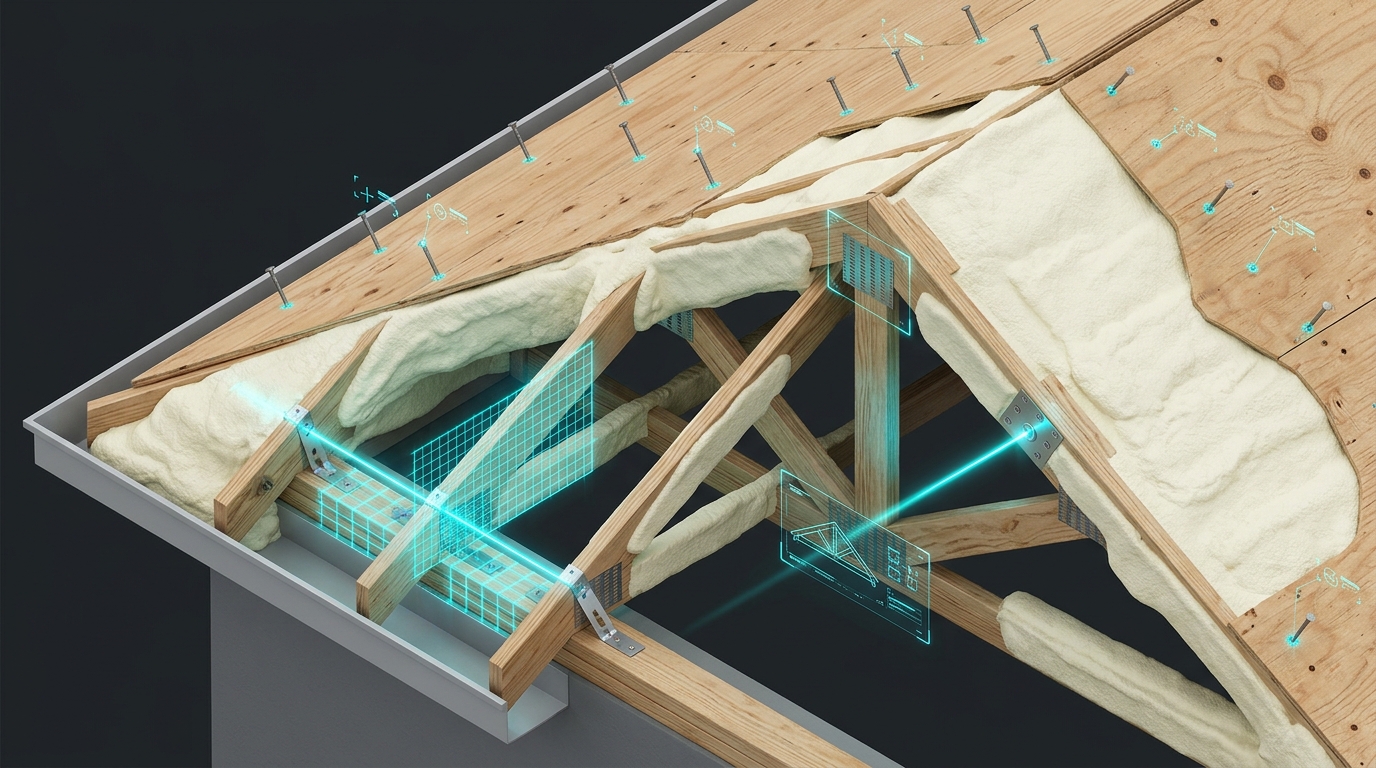
3D Isometric cutaway: Dense spray foam coating the underside of roof sheathing, obscuring metal hurricane tie-down straps, nail spacing, and structural truss connections required for Florida Form OIR-B1-1802.
Property insurers across Florida maintain some of the most rigorous inspection standards in the United States. To underwrite a policy or grant substantial annual premium credits, carriers require independent inspectors to verify exactly how a roof is constructed. While spray polyurethane foam (SPF) is widely marketed for superior thermal efficiency and energy savings, it has quietly triggered widespread friction in Florida’s volatile insurance market.
Homeowners across South Florida, Tampa Bay, and Central Florida frequently discover that their closed-cell or open-cell spray foam roof deck is causing wind mitigation discounts to be denied, renewals to skyrocket, or carriers to outright refuse coverage. Understanding the underlying building science and insurance mechanics is vital to safeguarding your investment.
1 It Blocks the Inspector’s View (The Wind Mitigation Dilemma)
In Florida, wind mitigation inspections (conducted via official Form OIR-B1-1802) are the single most effective way to lower home insurance premiums. Discounts depend heavily on verifiable photographic evidence of three key elements:
Roof Deck Attachment
Fastener type (8d vs. 6d nails) and nail spacing along trusses (6-inch vs. 12-inch grid).
Roof-to-Wall Connection
Hardware type: Toe-nails, hurricane clips, single wraps, or double structural hurricane straps.
Secondary Water Resistance
Sealed roof deck barrier (self-adhering tape or polymer underlayment beneath shingles).
The Photographic Verification Catch
Spray foam applied via high-pressure gun adheres directly across the rafters and underside of the plywood or OSB deck. This seals all fasteners and metal connectors beneath 3 to 6 inches of solid foam. Because Florida law requires certified inspectors to provide clear, high-resolution photographs of these connectors, an inspector cannot verify what they cannot see. Without visual proof, underwriters are forced to default to the lowest credit tier (e.g., "toe-nails"), costing homeowners anywhere from $1,000 to over $3,500 annually in lost windstorm credits.
2 The Inability to Detect Roof Leaks & Structural Rot
Underwriters evaluate risk through the lens of catastrophic claims. In a traditional vented attic insulated on the floor, a roof leak quickly drips down onto the ceiling drywall, creating a visible water spot. While inconvenient, the homeowner detects the issue within days, allowing for a localized, manageable roof repair.
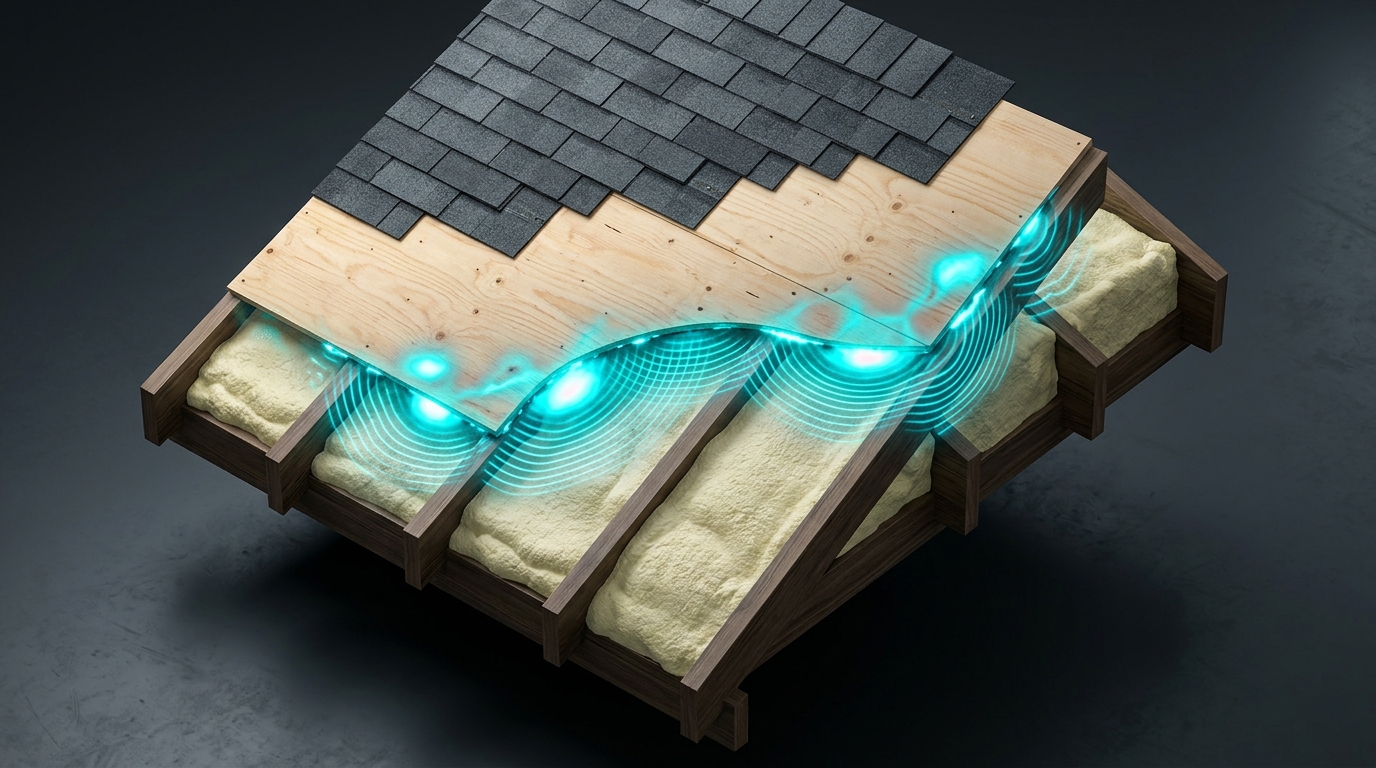
3D Isometric diagnostic scan: Rainwater entering cracked roof shingles becomes trapped between the wooden roof deck and the impermeable foam barrier, causing hidden structural rot.
With spray foam—particularly dense closed-cell foam applied to the roof deck—the foam acts as an impermeable shield. If a hurricane, aging shingles, or compromised tile underlayment allows water to penetrate the roof sheathing, the water cannot escape into the attic. Instead, the water is trapped directly against the plywood:
- Invisible Decay: The moisture remains sandwiched between the exterior waterproofing and the interior foam layer, remaining completely undetected for months or even years.
- Structural Failure: Over time, the structural wood sheathing and rafters rot from the inside out. By the time dampness shows on an interior wall or ceiling, the structural framing may be compromised.
- Exorbitant Claims: Instead of a $1,500 roof leak repair, the insurer faces a $50,000+ claim requiring complete roof tear-off, rafter rebuild, and extensive mold remediation.
3 Chemical Installation Hazards & Off-Gassing Liability
Spray polyurethane foam is not an off-the-shelf product; it is a live chemical reaction manufactured directly inside your attic. The applicator must balance a strict 1:1 volumetric ratio of Part A (isocyanates) and Part B (polyol resins, catalysts, and blowing agents), while carefully calibrating substrate temperatures and pass thickness.
Extreme Attic Heat Curing
In Florida, unconditioned attics regularly surpass 120°F to 140°F. If foam is sprayed in thick passes without adequate cool-down time, the internal core temperature can exceed 300°F, creating internal charring, shrinkage, and micro-fissures.
Off-Gassing & Persistent Odors
An off-ratio mixture leaves unreacted chemicals that off-gas volatile organic compounds (VOCs) and unpleasant amine odors (often described as a fishy or chemical stench). This has historically led to high-profile lawsuits, making risk adjusters wary of non-certified installations.
Action Plan: What to Do If You Own or Plan to Buy a Home with Spray Foam
Having spray foam does not mean you are uninsurable. By following these three proactive strategies, you can validate your roof's compliance, secure maximum insurance credits, and avoid policy cancellations.
Preserve Pre-Foam Builder Records
If your home was recently constructed or re-roofed with factory foam, obtain signed engineering plans, architectural submittals, and pre-drywall inspection photo logs. Official county-stamped records proving hurricane straps were code-compliant before foam was sprayed are accepted by major carriers.
Opt for Open-Cell When Retrofitting
For residential retrofits in Florida, low-density open-cell foam (0.5 lb/cu.ft) is generally preferred for roof decks because it is vapor permeable. If an exterior roof leak develops, water migrates through open-cell foam and drips, giving you early warning before structural decking collapses.
Consult an Independent Broker
While major national carriers (like State Farm or Allstate) may not maintain blanket bans nationwide, Florida underwriters operate under unique guidelines. An independent, multi-carrier broker knows which specific Florida-admitted and surplus lines carriers currently accept spray foam roof decks.
Open-Cell vs. Closed-Cell Foam: Florida Insurance Comparison
| Feature | Open-Cell Foam (0.5 lb) | Closed-Cell Foam (2.0 lb) |
|---|---|---|
| Leak Detection | Water percolates through; visible drip warns of roof breach early. | Waterproof barrier; can trap moisture against wood sheathing silently. |
| Wind Mitigation Visibility | Easier to cut small test cores or probe to reveal fastener clips. | Extremely hard to probe; requires destructive chiseling to expose straps. |
| Structural Rack Strength | Minimal structural racking resistance added to rafters. | Significantly increases roof diaphragm shear strength against high winds. |
| Insurance Underwriter Sentiment | Generally preferred for Florida residential sloped shingle roofs. | Requires rigorous documentation, engineering letters, or specialized riders. |

3D Isometric perspective: An engineered, conditioned attic environment featuring active humidity control, real-time environmental monitoring, and certified architectural documentation.
The SaniEffect Sealed Attic Conditioning Standard
Building Science Remediation & Protection ProtocolIf you have an unvented spray foam attic in Florida, building science dictates that your attic cannot simply be sealed and forgotten. Because conditioned attics are part of your thermal envelope, any trapped humidity from cooking, laundry, or showers that rises into the attic can condense and trigger hidden microbial colonies.
Active Dehumidification
Maintaining relative humidity below 50% permanently stops condensation traps on cold AC ducts and structural rafters.
Sani Attic Guardian (ActivePure®)
Continuous photocatalytic oxidation sanitizes air particles and neutralizes off-gassing chemical compounds 24/7.
Planning a Purchase or Roof Renovation in Florida?
The exact impact on your insurance policy depends on two critical factors:
- Roof Covering: Is your home covered with asphalt shingles, concrete tiles, or standing-seam metal?
- Application Coverage: Was the spray foam applied across the entire deck surface (unvented hot roof) or strictly along the structural truss seams (secondary water barrier / nail enhancement)?
Contact our diagnostic team today to discuss your attic’s configuration, review your wind mitigation inspection photos, or schedule a certified moisture evaluation.
Protect Your Home and Your Policy
Whether you need a thermal moisture assessment behind your spray foam or want to optimize your attic IAQ, SaniEffect provides certified, scientific evaluation.