
Across South Florida, homeowners and property managers frequently discover water stains blooming across second-floor ceilings or observe liquid droplets actively raining from ceiling air conditioning vents. The immediate reaction is almost universally to call an HVAC technician to "fix the leaking AC."
However, extensive forensic building investigations reveal a far more systemic truth: sweating ducts and saturated ceiling drywall are rarely isolated mechanical defects. They are the unmistakable visible symptom of a critical failure in the building envelope—a phenomenon we term the Unbalanced Attic Syndrome. When an attic space is improperly sealed from external weather, hot and humid tropical air infiltrates uncontrollably, initiating a destructive chain reaction that degrades structural assemblies, triggers black mold colonization, and contaminates the breathable air supply of the entire home.
1. The Physical Mechanism: The Origin of Extreme Duct Sweating
The thermodynamic laws governing Florida attics are unforgiving. During summer and transitional seasons, outdoor ambient temperatures frequently exceed 90°F with relative humidity levels surpassing 80% to 90%. When the attic thermal boundary is breached, this superheated moisture reservoir invades the roof cavity:
1. Envelope Infiltration
Unsealed soffits, roof-to-wall junctions, gable penetrations, or ruptured spray foam allow outdoor vapor to flood the attic, driving the ambient dew point above 75°F–78°F.
2. Dew Point Crossing
Central air handlers blast chilled supply air at 52°F to 55°F through metal or flexible ducts. When 75°F dew point attic air touches the 55°F duct surface, rapid condensation occurs.
3. Gravity Cascade
Ducts begin "sweating" continuously. Gravity pulls droplets down onto the 2nd-floor drywall ceiling, soaking insulation and cascading through wall chases to 1st-floor ducts and ceilings.
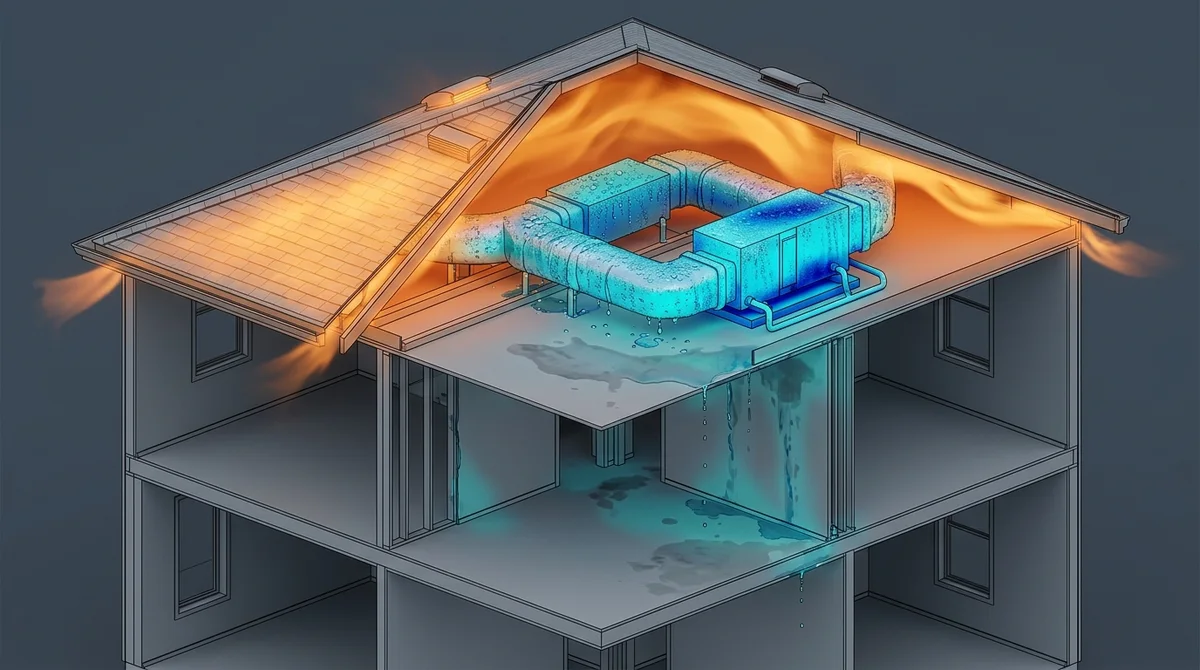 Forensic Architectural Cutaway: Outdoor vapor infiltration triggers widespread duct sweating in the attic, saturating 2nd-floor drywall and cascading to 1st-floor ceiling assemblies.
2. Structural Damage & Fungal Colonization: The FLIR Forensic Evidence
Liquid condensate dripping into ceiling cavities does not remain inert. Gypsum drywall is faced with cellulose paper—a prime organic nutrient source for biological growth. The moment surface water activity reaches water activity aw ≥ 0.70 (equivalent to sustained moisture content above 16%–19% in building materials), dormant fungal spores germinate within 48 to 72 hours.
Cellulose Drywall & Truss Decay
Unchecked condensate saturates ceiling panels, causing paper delamination, structural sagging, and microbial colonization of yellow pine roof trusses. Over months, repeated wetting leads to dry rot and catastrophic drywall collapse.
FLIR Infrared Forensic Mapping
During forensic inspections, high-resolution FLIR thermography exposes distinct evaporative cooling thermal anomalies (deep purple/blue zones), uncovering massive moisture pockets trapped behind finished plaster and within fiberglass batt insulation.
Diagnostic Field Reality
In a recent forensic investigation of an unsealed two-story estate, ceiling thermal imaging revealed widespread moisture patterns registering up to 99% relative wood moisture equivalent (WME) along duct chases, while the ceiling surface visually appeared completely dry to the naked eye.
3. The HVAC System as a Contamination Vector: The Venturi Effect
In multi-story residential properties, it is common to locate two central air handler units inside the attic space. When these mechanical units, return plenums, filter racks, and duct collar junctions are not sealed with airtight mastic paste and UL 181 tape, a dangerous aerodynamic phenomenon takes over: The Venturi Effect.
Bernoulli’s Principle in Attic HVAC Systems
As high-velocity blower fans propel air through the mixing box, localized air velocity accelerates, creating a dramatic drop in internal static pressure. This static pressure deficit creates an intense vacuum effect at every unsealed seam, screw hole, and foil-tape tear along the air handler and return plenum.
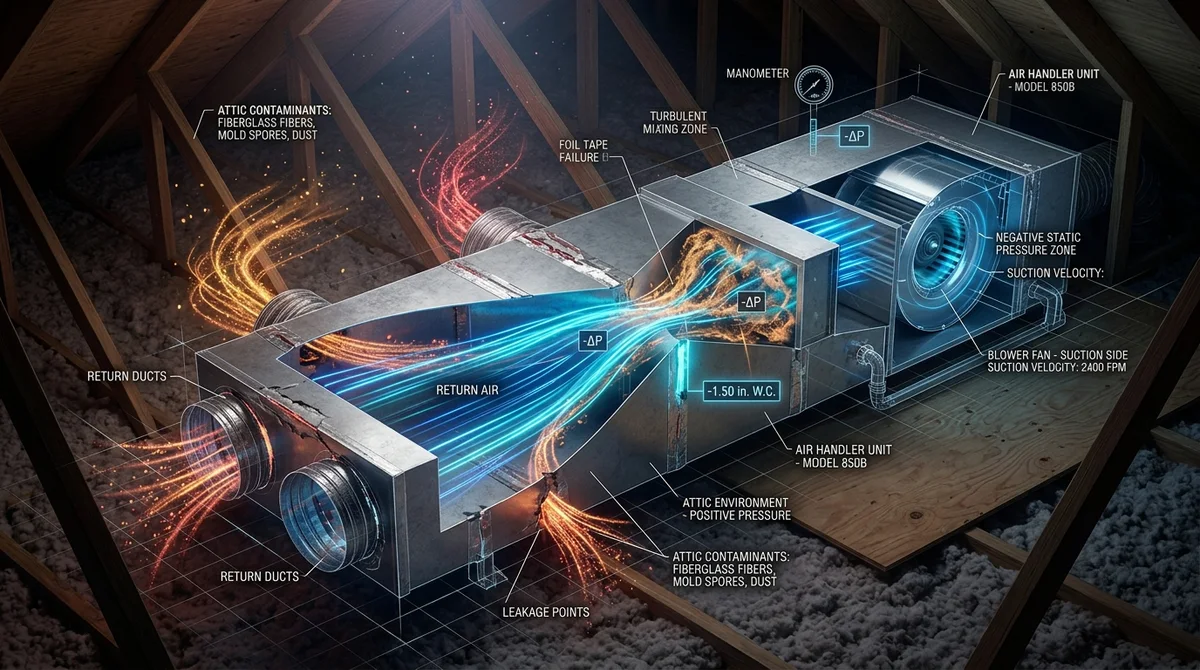 Forensic Aerodynamic Cutaway: High-velocity airflow inside unsealed air handlers generates Venturi negative pressure, violently sucking dusty attic air and fungal spores into the home's breathable air distribution network.
Instead of circulating filtered, conditioned air, the HVAC system transforms into an active aerosol vacuum. It draws superheated attic air laden with fiberglass particulates, decomposed insect detritus, rodent dander, and fungal conidia straight into the cooling coil and supply ductwork. Inside the damp, dark duct interior, spores adhere to dust layers, colonizing fiberglass liners and metal trunks, and blowing biological contaminants into every bedroom.
4. Depressurization & Cross-Contamination: The Spray Foam Attic Dilemma
Many homeowners invest in spray foam roof deck insulation believing it automatically guarantees a pristine, healthy attic. However, in Florida building science, an unvented spray foam attic without meticulous pressure balancing and absolute envelope hermeticity creates a dangerous moisture trap.
When a spray foam attic retains hidden roof breaches or unsealed soffit leaks, the air volume inside becomes semi-conditioned yet highly volatile. When exhaust fans (kitchen hoods, bathroom blowers) or leaky HVAC return ducts operate, the living space below falls into a state of negative house depressurization relative to the attic:
Recessed Can Lights
Non-airtight fixtures act as open chimneys connecting contaminated attic air directly to bedrooms.
Pendant & Electrical Chases
Unsealed wiring penetrations and chandelier junction boxes allow invisible downward vapor migration.
Duct Boot Can Margins
Gaps between the metal ceiling register box and the drywall cutouts bleed attic air directly into living zones.
The Toxic Inversion
Because spray foam seals the roof deck from venting outdoors, off-gassed chemicals, microbial volatile organic compounds (mVOCs), and aerosolized fungal fragments cannot escape into the sky. Instead, the negative pressure of the living space continuously siphons this concentrated chemical and biological cocktail straight down into family living quarters.
5. Health Risks Beyond Spores: Mycotoxins & Immune Disruption
The greatest health threat posed by attic-induced duct colonization is not merely the presence of intact, visible mold spores. When mold species such as Aspergillus versicolor, Penicillium chrysogenum, and Stachybotrys chartarum proliferate on wet drywall and inside dark, humid duct liners, they synthesize toxic secondary metabolites known as mycotoxins:
Sub-Micron Penetration
Mycotoxins and (1→3)-β-D-glucans adhere to ultra-fine dust particles smaller than 0.1 microns. These nano-particulates easily pass through standard 1-inch MERV air filters, penetrating deep into pulmonary alveoli and passing directly into the human bloodstream.
Impact on CIRS & Sensitive Individuals
In occupants genetically susceptible to Chronic Inflammatory Response Syndrome (CIRS), asthma, or autoimmune conditions, chronic exposure to attic-siphoned mVOCs and trichothecenes triggers relentless fatigue, chronic sinus infections, cognitive brain fog, and severe respiratory distress.
Independent AIHA-Accredited Laboratory Validation
Forensic remediation requires definitive diagnostic verification. Under the ANSI/IICRC S520 Standard for Professional Mold Remediation, indoor air and surface conditions must be classified by independent AIHA-accredited laboratories. Contaminated attic assemblies and unsealed HVAC systems represent Condition 3 (Actual Fungal Growth), demanding strict engineering containment before any demolition or cleaning begins.
6. The Sani Effect 5-Phase Engineered Mitigation Protocol
Eradicating sweating ducts and attic-driven mold contamination requires a holistic building science strategy. Simply replacing ductwork or wiping ceiling drywall without addressing envelope physics guarantees failure. Sani Effect Environmental executes a disciplined 5-phase corrective protocol:
| Phase | Action Zone | Corrective Engineering Measure |
|---|---|---|
| 1 Envelope | Attic / Roof Assembly | Complete air-sealing of external envelope breaches, soffit leak points, and vapor barrier restoration to stop bulk humidity infiltration. |
| 2 HVAC System | Plenums, Returns & Boots | Mastic paste and fiberglass mesh reinforcement on all air handler collars, return plenums, and boot cans to permanently eliminate Venturi negative pressure suction. |
| 3 Penetrations | Ceiling Drywall Boundary | Hermetic air-sealing of recessed can light housings, pendant electrical boxes, and drywall-to-boot junctions to block cross-contamination pathways. |
| 4 Remediation | Drywall & Wood Trusses | Surgical extraction of water-damaged drywall and clinical antimicrobial micro-cleaning of roof trusses under continuous HEPA negative air containment (IICRC S520). |
| 5 Climate & IAQ | Whole-Home Environment | Installation of dedicated whole-home dehumidification maintaining 45%–50% RH year-round, plus ActivePure® Advanced Photohydrolysis Technology inside the supply plenum. |
Engineering & Building Science References
This technical analysis synthesizes consensus standards from the leading authorities in forensic building physics, mechanical HVAC engineering, and environmental health:
American Society of Heating, Refrigerating and Air-Conditioning Engineers. Ventilation and Acceptable Indoor Air Quality in Residential Buildings. Establishes critical airflow balancing and indoor moisture limits.
Institute of Inspection Cleaning and Restoration Certification. Standard for Professional Mold Remediation. Mandates protocols for Condition 3 contamination, negative pressure engineering, and post-remediation verification.
Lstiburek, J. (Building Science Press). Unvented Roof Systems & Duct Dynamics in Hot-Humid Climates. Analyzes interstitial dew point crossing and attic depressurization physics.
United States Environmental Protection Agency. Mold Remediation in Schools and Commercial Buildings. Guidelines on HVAC biological growth and porous material extraction standards.
Notice Sweating Ducts or Ceiling Water Stains?
Do not wait for ceiling drywall to collapse or toxic mold to colonize your air distribution network. Schedule an immediate forensic building science evaluation with FLIR thermal moisture mapping and certified laboratory diagnostics.