
The Core Enigma: Invisible Contamination
One of the most frequent phone calls we receive at Sani Effect begins with this exact sentence: "My family has developed chronic sinus inflammation, unexplained fatigue, and persistent coughing, but our home is spotless—there isn’t a single trace of mold on any wall."
In professional indoor environmental forensics, this is not a contradiction; it is a textbook consequence of Building Thermodynamics and Pressure Differentials. A home is not a static set of isolated rooms. It is a dynamic pneumatic machine driven by heat, humidity, and the Stack Effect. As air naturally circulates through structural pathways you cannot see, it draws millions of microscopic fungal spores from crawlspaces, wall chases, and attics, depositing them directly into the air your family breathes every minute of the day.
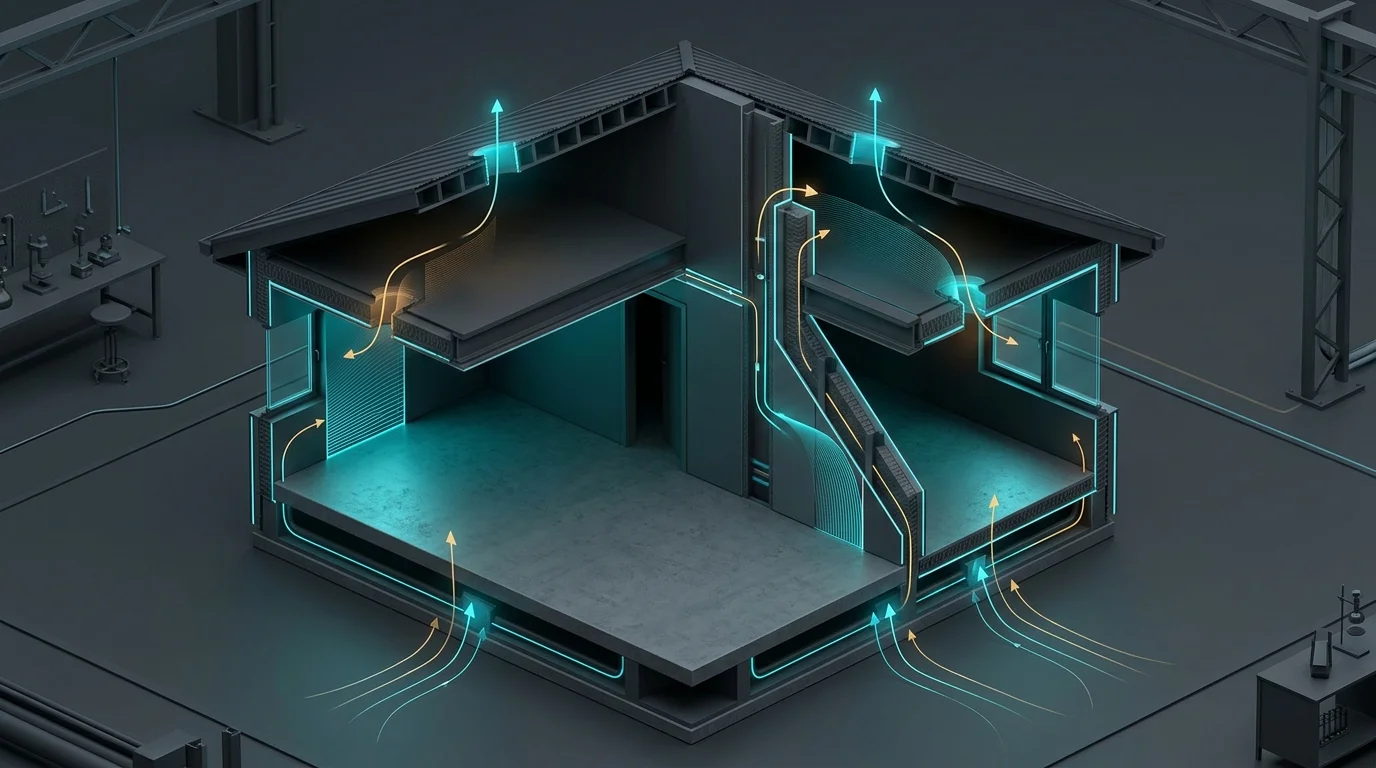
SaniEffect Stack Effect & Pressure Simulator
01 The Physics: What Is the Stack Effect?
In architectural engineering, the Stack Effect (or chimney effect) is the movement of air into and out of buildings, driven by buoyancy forces. Buoyancy occurs when there is a difference in indoor-to-outdoor air density, resulting from temperature differences.
Density Law ($\rho = P / RT$)
Warm air is less dense than cold air. Because warm air molecules vibrate faster and occupy more volume, a cubic foot of warm air weighs measurably less than a cubic foot of cool air. This fundamental rule creates vertical buoyant uplift.
Pressure Differentials ($\Delta P$)
The pressure difference between the top and bottom of a structure is directly proportional to building height and the temperature gradient between indoor air and outdoor atmosphere ($\Delta P \approx C \cdot h \cdot (\frac{1}{T_o} - \frac{1}{T_i})$).
In a traditional heating climate (such as northern states or winter months), warm heated air inside the home rises toward the roof, expanding and exerting positive pressure against the ceiling drywall and roof vents. As this warm air escapes, it creates a powerful negative pressure (suction) at the base of the home. This vacuum siphons outdoor air, damp crawlspace air, and subterranean soil vapors upward through floor joists and wall cavities to replace the departing air mass.
The "Reverse Stack Effect": Why Florida Homes Suffer Worse
Most generic articles online only discuss cold-climate stack effect. But if you live in Florida, coastal Georgia, or the Gulf Coast, your building experiences the exact opposite phenomenon for over 9 to 10 months of the year: The Reverse Stack Effect.
Cold Air Sinks Like Water
When your high-efficiency AC system cools the interior to 72°F while the outside temperature is 95°F with 85% relative humidity, the indoor air becomes dense and heavy. It falls toward the ground floor, creating positive pressure against lower floor slabs and exterior doors.
Ceiling Vacuum Infiltration
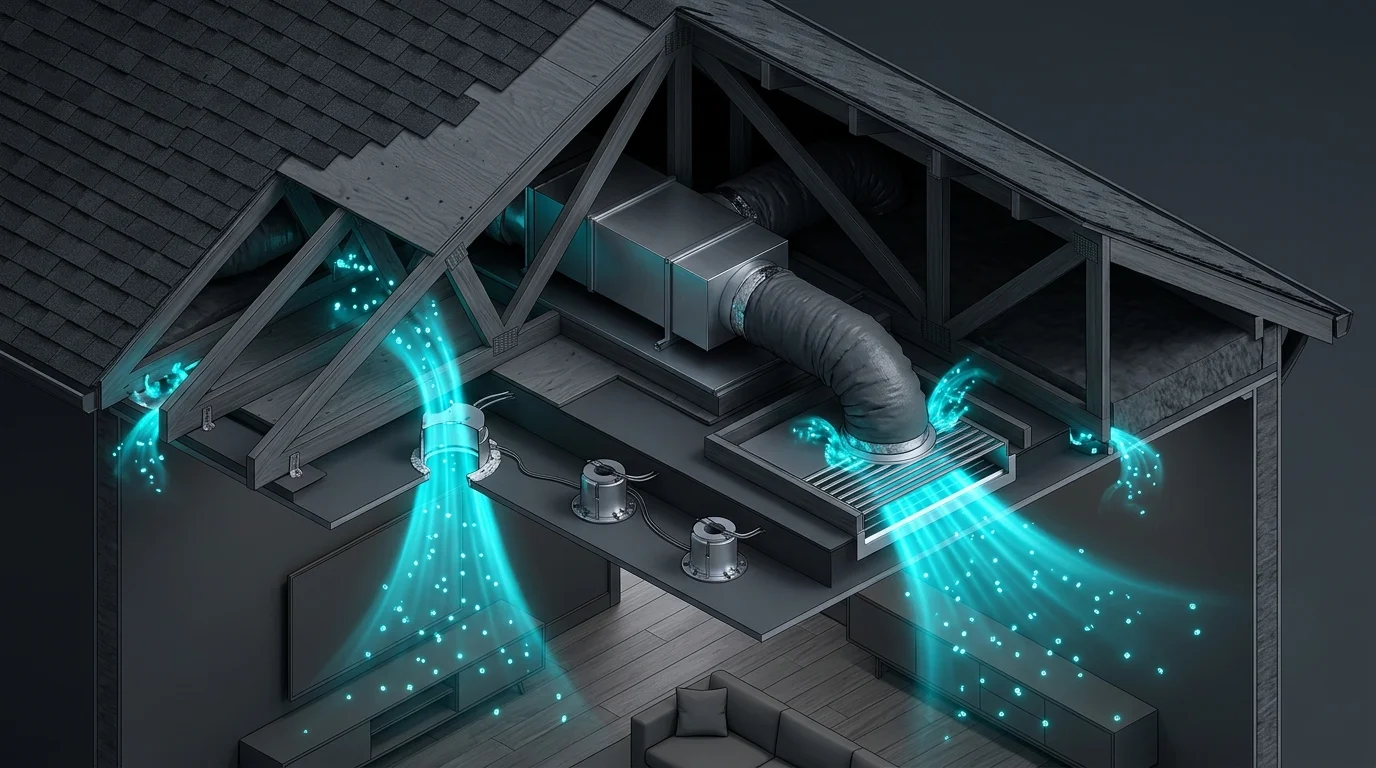
Because cold air is escaping or pressing downward, it creates a strong negative pressure vacuum at the ceiling plane. This suction forces 130°F, vapor-saturated, spore-laden attic air straight down through recessed can lights, ceiling fans, and drywall seams.
The Condensation Trap: When that 130°F attic air (with a dew point of 78°F) hits drywall or metal supply boots cooled to 68°F by your AC, flash condensation occurs inside the ceiling assembly. It creates an invisible, dark tropical breeding ground for mold directly above your children's beds.
02 The 4 Hidden Highways Mold Spores Exploit
Mold spores range between 1 to 20 microns in diameter—so microscopic that they remain suspended in air currents indefinitely like invisible dust. During stack-driven pressure differentials, air flows through the path of least mechanical resistance. These are the four major structural highways in modern homes:
1. Recessed Ceiling Can Lights
Standard unsealed IC/non-IC recessed light fixtures have dozens of factory punch-outs and perimeter gaps. They function like continuous open chimneys. In Florida's reverse stack effect, hundreds of cubic feet of unconditioned attic air and airborne spores are sucked through these cans into your bedrooms every single day.
2. Plumbing Chases & Wall Cavities
Plumbing stacks, electrical chases, and bathtub cutouts penetrate floor plates from the foundation all the way through the top plate into the attic. These wall cavities act as hollow vertical draft flues, pulling subterranean mold spores and soil moisture right behind interior sheetrock.
3. Return Air Plenums & Ducts
Air handling units (AHUs) located in attics or garages pull hundreds of Pascals of negative static pressure on their return side. If the return box or flex-duct junctions have minor tears or gaps, the HVAC system literally vacuums dusty, mold-colonized attic air and atomizes it across every room.
4. Foundation Slab & Crawlspace Soils
Crawlspaces and unsealed concrete stem walls are in perpetual contact with damp Florida earth. When stack pressure draws air upward, raw soil spores (such as Aspergillus and Cladosporium) are wicked into floor assemblies, wicking into subflooring and luxury vinyl plank (LVP) backing.
03 The IICRC S520 Truth: Condition 1 vs. Condition 2
Homeowners frequently assume that if their walls look clean, their home is healthy. However, the international remediation benchmark—the IICRC S520 Standard for Professional Mold Remediation—categorizes indoor fungal ecology into three distinct tiers:
| Ecology State | Physical Characteristic | Stack Effect Interaction |
|---|---|---|
| Condition 1 | Normal Fungal Ecology (Clean structural environment with spore counts matching outdoor background). | Air movements exchange clean air without concentrating fungal particulates. |
| Condition 2 (Settled Spores) | No visible mold growth, but elevated airborne spores, settled mycelial fragments, and mycotoxins in living spaces. | Directly caused by the Stack Effect! Air currents continually siphon hidden spores from attics/crawlspaces into living areas without active visible colonies on walls. |
| Condition 3 | Active visible fungal growth on indoor building materials (drywall, wood framing, baseboards). | Occurs when Condition 2 spores find persistent condensation from dew-point traps. |
Why Conventional "Room-by-Room" Contractors Fail
Most conventional remediators treat mold like a cosmetic problem. If you discover mold under a kitchen cabinet, they scrub the cabinet and walk away. But if the stack effect has been siphoning those spores through the building envelope for 18 months, your entire home is in a state of Condition 2 contamination. When air moves, spores settle into upholstered furniture, carpeting, mattresses, and HVAC insulation.
The Sealed Attic & Spray Foam Aggravation
In recent years, many South Florida homeowners installed spray foam insulation on their roof decks to lower power bills. While spray foam is an excellent thermal barrier, it fundamentally changes the building envelope physics:
Sealing the soffits and ridge vents eliminates natural thermal exhaust. Any moisture generated inside the home rises and stays trapped in the attic envelope.
As the sealed attic air heats and cools, pressure swings turn the attic into a giant pneumatic syringe, injecting trapped odors and spores into bedrooms below.
If old fiberglass insulation was left on the attic floor beneath the new spray foam, it acts as a moisture sponge, harboring toxic mycotoxins in complete darkness.
04 The Sani Effect Protocol: Engineering Permanent Solutions
Eliminating stack-effect mold spread cannot be accomplished with a spray bottle of bleach or a quick wipe-down. At Sani Effect, our solutions are engineered by mechanical engineers and licensed environmental consultants adhering strictly to building science principles:
1. Envelope Diagnostics & Pressure Mapping
We don't guess—we measure. Using precision digital manometers, thermal infrared imaging (FLIR), and building envelope smoke pencil testing, we map the exact pressure differentials (ΔP) between your living area, attic, and crawlspace.
- Identification of ceiling top-plate breaches and unsealed chases
- HVAC static pressure testing to locate return-side leakage
- Psychrometric dew-point calculations across building assemblies
2. Strategic Air Sealing & Penetration Barriers
We eliminate the highways. Our technicians mechanically seal recessed can lights with fire-rated airtight enclosures, foam-seal plumbing chases and electrical knockouts at top plates, and seal attic hatches with weatherstripped, gasketed access panels. Stopping the airflow stops the transport of mold spores.
3. ActivePure® Advanced Photohydrolysis Technology
Standard passive HEPA filters only clean air that happens to pass through their fibers. Because the stack effect distributes spores throughout living zones continuously, Sani Effect integrates ActivePure® Advanced Photohydrolysis Technology.
ActivePure sends microscopic, safe antimicrobial hydroperoxides throughout your ambient air and onto every surface, actively neutralizing airborne fungal spores, bacteria, and viruses in real-time as they attempt to migrate through rooms.
4. IICRC S520 Restoration & Independent 3rd-Party Lab Clearance
When Condition 2 or Condition 3 contamination exists, Sani Effect executes a clinical 16-step remediation protocol under strict negative pressure containment. In full compliance with Florida DBPR Section 468.8419, all post-remediation clearance testing (PRV) is verified by independent, third-party State-Licensed Mold Assessors (MRSA) and AIHA-accredited laboratories. We never inspect our own remediation work—guaranteeing 100% unbiased peace of mind.
 Author & Engineer
Enrique J. Muniz, MS, MRSA, MRSR
President & CEO | Sani Effect Environmental, Inc.
Enrique J. Muniz holds a Master of Science in Mechanical Engineering and is a dual-licensed Florida Mold Assessor (MRSA 2250) and Mold Remediator (MRSR 2425) with over 15 years of forensic building science experience. He specializes in psychrometrics, commercial HVAC aerodynamics, and designing restorative protocols for complex moisture-damaged environments across South and Central Florida.
Suspect Invisible Mold Spreading in Your Home?
Do not wait for active black mold to rot your drywall. If your family is suffering from unexplained symptoms or you suspect attic pressure infiltration, let our certified team perform a comprehensive building envelope assessment.
Serving Palm Beach, Martin, St. Lucie, Indian River, and surrounding Florida coastal counties.