

Sani-Effect Technical Team
Licensed Mold Remediation Contractors (MRSR / MRSA) & Environmental Biosecurity Specialists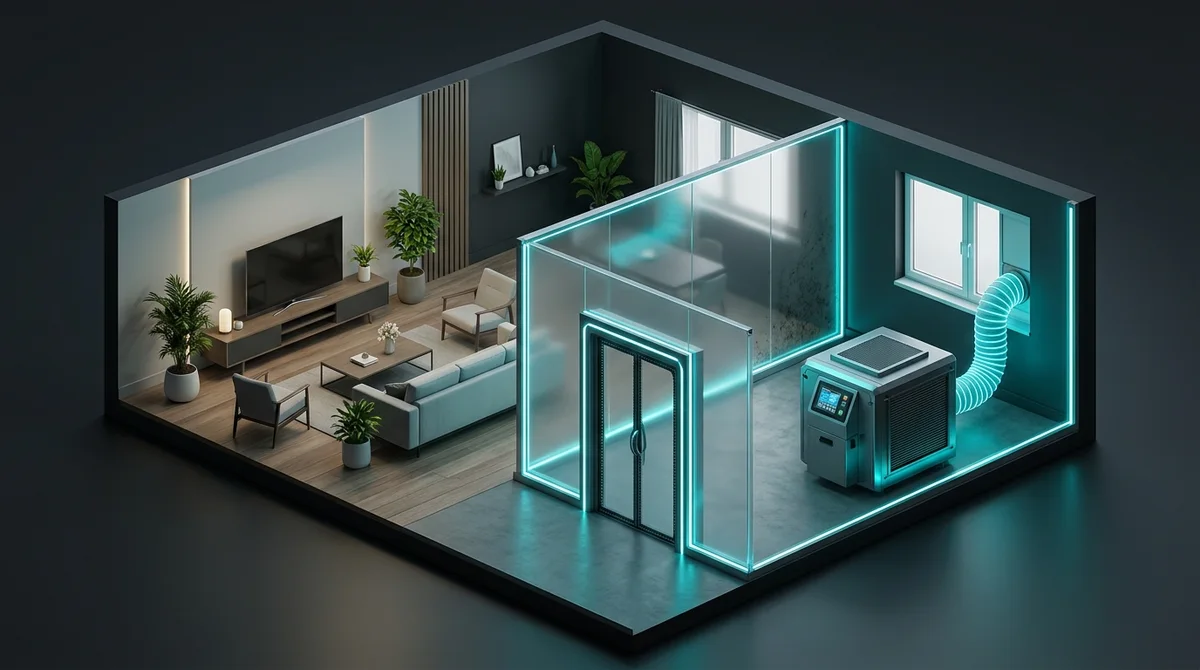 Figure: 3D architectural cutaway illustrating a modern residential home split between peaceful living quarters (left) and an active, sealed negative-pressure remediation chamber with HEPA exhaust ventilation (right).
As with most major residential environmental restoration projects, remaining in your home during mold remediation is often possible, but by no means always practical, comfortable, or safe. While staying put avoids the out-of-pocket costs and logistical headache of booking short-term housing, living inside an active remediation site subjects your family to continuous equipment noise, severe climate control disruptions, trade traffic, and potential spore exposure risks.
The Homeowner's Core Dilemma
Deciding whether to stay or relocate comes down to evaluating a wide spectrum: on one end is a minor, localized containment zone in an isolated guest bathroom, while on the other end is a fully-involved multi-room remediation requiring whole-home HVAC shutdown and a full furniture packout.
1. Which Living Areas and Vital Systems Are Affected?
The physical location of the mold contamination heavily dictates whether your family can realistically function day-to-day:
Kitchen Access
If cabinets, sinks, or subflooring are under containment, you cannot prepare food. Living on microwave meals in a hallway gets old in 24 hours.
Primary Bathrooms
If your master bath is the only functional shower and toilet in the home, living outside the containment zone is virtually impossible.
HVAC Shutdown
If supply or return plenums have mold, the entire central AC must be locked out to prevent blowing millions of agitated spores everywhere.
In Florida's humid climate, the HVAC shutdown factor is critical. If remediation technicians must treat the air handler, plenums, or duct trunklines, your air conditioning cannot operate. Within 4 to 6 hours during a Florida summer, indoor temperatures can easily soar past 85°F to 90°F with relative humidity exceeding 75%.
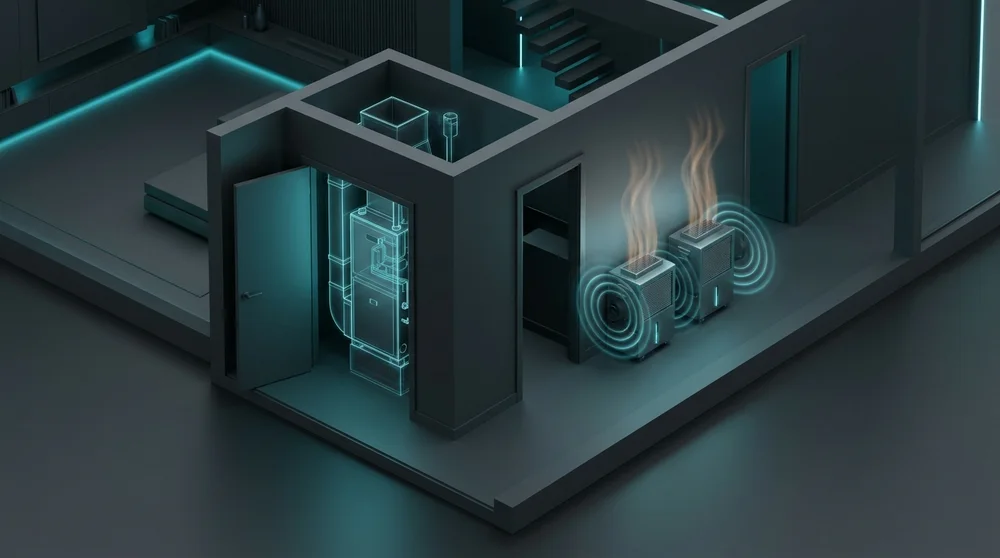 Figure 1: Architectural visualization of mechanical HVAC shutdown with diagnostic lockouts, while commercial HEPA scrubbers and industrial dehumidifiers produce thermal heat dissipation and continuous acoustic motor vibrations.
2. How Extensive Is the Remediation Work Scope?
Scope of work is often the single most decisive factor when choosing whether to vacate. Remediation protocols under the IICRC S520 Standard for Professional Mold Remediation vary widely based on total square footage of affected porous materials:
Isolated Closet or Wall
Under 10 sq. ft. of localized drywall or cabinet backing. Simple mini-containment with zipper door. Safe & Practical to Stay Home.
Multi-Room / Living Space
30 to 100+ sq. ft. of active removal across bedrooms or hallways. Negative air exhaust routing out windows. Selective Relocation Recommended.
Whole-Structure Packout
Extensive fungal colonization throughout flooring, wall cavities, or attic/crawlspace. Personal contents packed out. Must Vacate Residence.
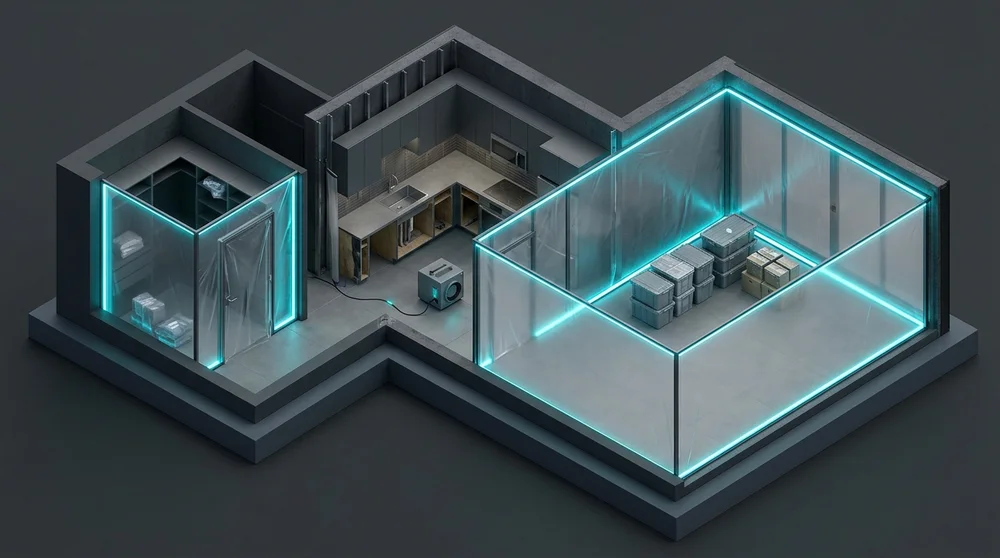 Figure 2: Architectural scope comparison showing isolated closet containment (Zone A), open kitchen cabinetry extraction (Zone B), and complete living space packout with stacked storage containers (Zone C).
Contractor Insight: Timeline & Project Efficiency
When homeowners remain inside a residence during medium-to-large projects, remediation technicians must spend significant daily billable labor constructing temporary plastic hallways, maintaining security zipper seals, and vacuuming transit corridors every morning and evening. Vacating often shortens project timelines by 25% to 40% and reduces total labor billing.
3. What Is Your Tolerance for Constant Equipment Noise?
Effective containment requires establishing and maintaining continuous negative air pressure. This prevents contaminated air from leaking into unaffected living spaces:
- 24/7 Engine Hum: High-CFM negative air machines (industrial HEPA air scrubbers) and commercial LGR (low-grain refrigerant) dehumidifiers run continuously day and night.
- Decibel Levels: An industrial air scrubber typically operates at 65 to 72 decibels (dB) at 5 feet. This is equivalent to running a loud vacuum cleaner or dishwasher right next to your bed.
- Can You Turn Equipment Off at Night? Under no circumstances should you ever turn off containment machinery. Shutting down negative air scrubbers immediately collapses the pressure gradient, allowing pressurized airborne spores trapped in the work zone to seep past plastic seals and spread throughout your home.
4. How Sensitive to Mold Exposure Are You or Your Family?
Occupant health is the paramount consideration. During active physical remediation (cutting water-damaged drywall, wire brushing wood studs, HEPA vacuuming porous framing), airborne mold spore counts inside the sealed containment chamber spike to intermittent peak concentrations hundreds of times higher than baseline levels before work began.
Medical & High-Risk Vulnerability Advisory
Even with pristine containment and multi-stage HEPA filtration, technicians must enter and exit through airlock zipper chambers. If anyone in your household has asthma, Chronic Inflammatory Response Syndrome (CIRS), Lyme disease, severe fungal allergies, an autoimmune disorder, or if you have infants or elderly family members, remaining in the home during active demolition is strongly discouraged.
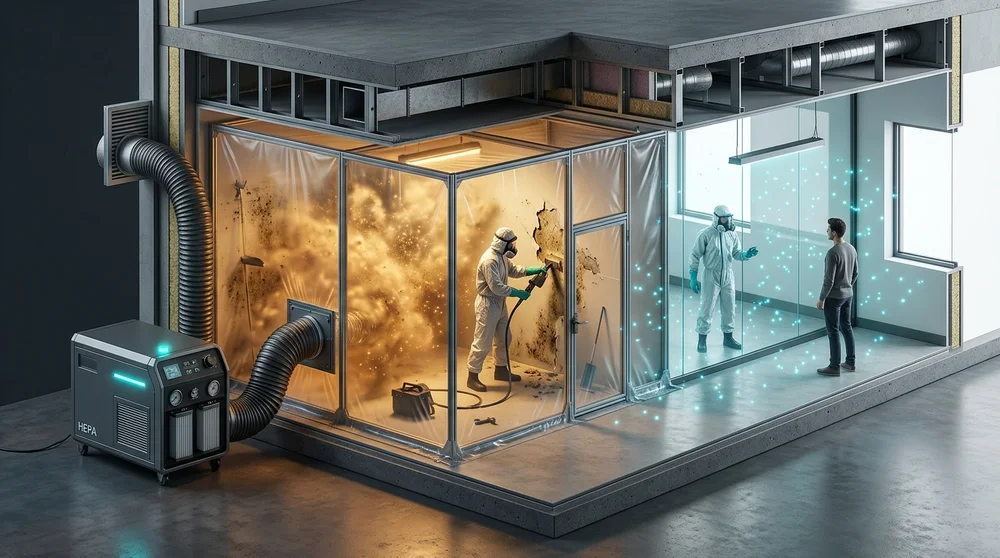 Figure 3: Laboratory-grade containment cross-section showing an active technician inside a sealed negative-pressure chamber capturing high spore peaks, while the adjacent living room maintains pristine, purified indoor air.
5. Indoor Thermal & Florida Climate Comfort Concerns
Operating heavy restoration machinery inside a residence generates an immense quantity of thermal energy:
A single commercial LGR dehumidifier and two 500-CFM HEPA scrubbers can dump between 8,000 and 15,000 BTUs of waste heat per hour directly into the structure. If your home's central air conditioning is operational in other zones, it will run continuously to offset this heat. However, if the AC must remain off due to duct contamination or shared return vents, staying in the home quickly becomes intolerable.
6. Post-Remediation Reconstruction & Rebuilding Disruption
Many homeowners mistakenly assume that once the mold is removed, normal living resumes immediately. However, mold remediation is followed by reconstruction:
- Hanging fresh drywall sheets and applying joint compound.
- Sanding drywall (which produces fine gypsum dust).
- Applying antimicrobial primer, texture, and interior paint.
- Installing new flooring, baseboards, cabinetry, and plumbing fixtures.
Because plastic containment barriers are removed once Post-Remediation Verification (PRV) clearance testing is passed, the construction phase can introduce general dust, chemical paint odors, and steady trade worker traffic into your primary living spaces.
Real South Florida Case Studies
Kitchen & AC Trunkline Contamination
The Situation: A family with a 9-month-old infant attempted to remain in their home during lower kitchen cabinet tear-out and return plenum decontamination.
The Challenge: Without kitchen water, combined with 24/7 noise from 3 air scrubbers and a 12-hour AC shutdown in 92°F heat, the living conditions quickly became unsustainable.
Isolated Master Closet Water Intrusion
The Situation: Fungal growth was strictly restricted to an 8x10 walk-in closet caused by an exterior window flashing leak. The master bedroom, bath, and central AC were 100% clean.
The Challenge: The homeowners worked remotely and preferred to stay in the home if airborne safety could be unconditionally guaranteed.
Summary & Quick Decision Matrix
Use this quick reference matrix to determine whether staying home or booking short-term accommodations makes the most sense for your project:
| Evaluation Factor | Safe / OK to Stay Home | Temporary Relocation Advised |
|---|---|---|
| Scope of Remediation | Single isolated closet, half-bath, or utility nook (< 20 sq. ft.) | Multiple rooms, entire ceiling, subfloors, or whole-home packout |
| HVAC & AC Operation | Air handler & ducts clean; central AC runs continuously in clean zones | Air handler or ductwork contaminated; AC must be powered off |
| Essential Facilities | Kitchen and at least one full bathroom remain 100% accessible | Kitchen or sole full bathroom is located inside the containment zone |
| Occupant Health Profile | Healthy adults with no known respiratory or mold sensitivities | Infants, elderly, asthma sufferers, CIRS patients, or pregnant women |
| Equipment Noise Tolerance | Can sleep comfortably with steady white noise (~65 dB in adjacent room) | Light sleepers, sensitive pets, or professionals working from home |
| Insurance Coverage | Self-paying out of pocket; striving to minimize total expenditure | Covered insurance claim with Additional Living Expense (ALE) benefits |
Frequently Asked Questions
Planning a Mold Remediation Project in Florida?
Our IICRC-certified environmental specialists will inspect your property, establish clinical negative-air containment, and provide an honest assessment of whether staying home is practical for your family.
Related Mold Education Guides

Truth About Air Duct Cleaning Scams & Mold
Why $99 rotary brush cleanings destroy flexible ductwork in Florida.
Read Guide →
Health Risks of Mold & Mycotoxins
How chronic indoor mold exposure triggers respiratory distress, brain fog, and CIRS.
Read Guide →
Why Spray Foam Complicates Florida Home Insurance
How spray foam creates blindspots for wind mitigation and roof deck inspections.
Read Guide →