
Across luxury high-rise towers and multi-family condominiums in Palm Beach, West Palm Beach, Boca Raton, and Jupiter, property owners and building managers frequently confront a perplexing problem: dark, fuzzy discoloration reappearing on air conditioning supply grills, accompanied by persistent musty odors every time the HVAC cycles on.
Wiping the exterior louvers of the grill with household cleaners provides only temporary relief. Within weeks, the dark spotting returns. The reason is simple: the exterior grill is merely the exhaust point of an internal ecosystem. The root of the infestation is anchored deep within the building's central ductwork, specifically inside the porous fiberglass duct board trunk lines hidden above your ceiling drywall.
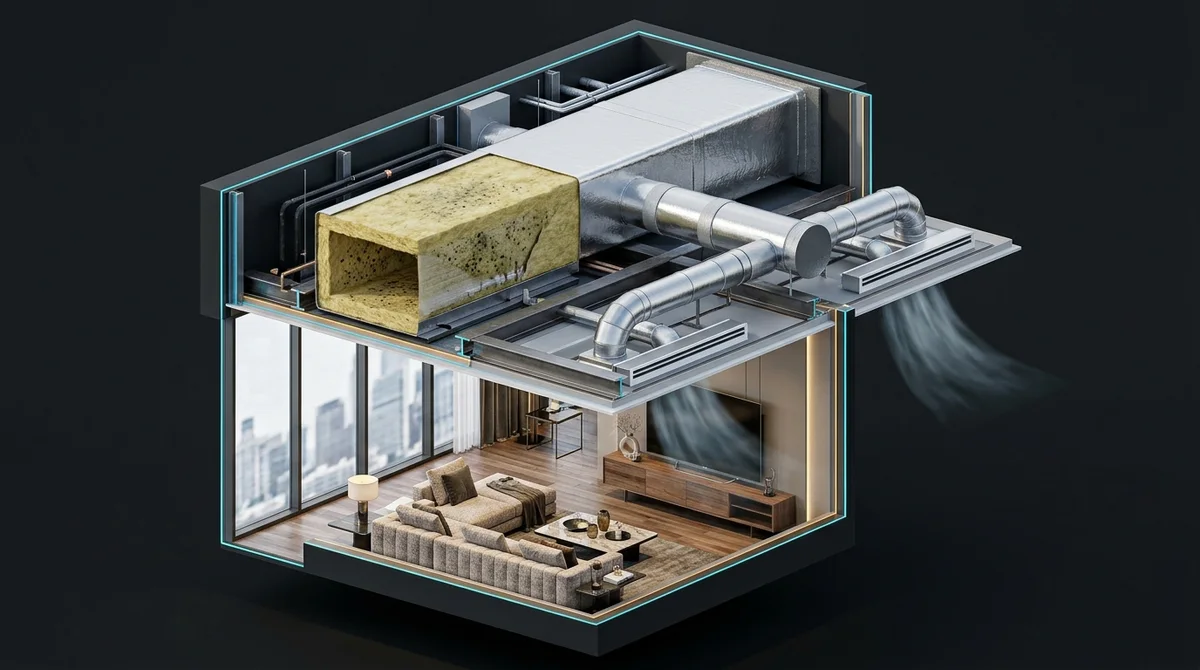 Architectural 3D Cutaway: Porous fiberglass duct board concealed behind drop drywall ceilings in modern Florida condominiums.
1. The Building Science of Fiberglass Duct Board in South Florida
Unlike single-family homes that often use circular flexible ducts or external sheet metal wraps, condominium architecture in Florida has historically relied heavily on rigid fiberglass duct board for main trunk lines and plenum mixing boxes. Duct board consists of resin-bonded inorganic glass fibers faced with a reinforced foil outer vapor barrier.
While fiberglass duct board provides excellent acoustic dampening (silencing air handler fan noise between compact condo rooms) and thermal insulation, its internal face exposed to the airflow creates a profound vulnerability in tropical marine climates:
High Internal Porosity
The inner walls of duct board are not smooth metal; they are an exposed web of woven glass fibers. Over 5 to 15 years of daily operation, microscopic skin cells, pet dander, cooking oils, and fine dust bypass standard 1-inch filters and embed deep into the fiberglass fibers.
The Dew Point Incubator
Central air conditioners blow chilled air (52°F to 55°F) through dark ductwork. In South Florida's humid climate, any off-cycle moisture infiltration or short-cycling elevates the internal relative humidity above 75%. Combined with darkness and embedded organic dust, the duct board becomes a perfect microbial culture dish.
The Industry Standard: NADCA ACR 2021 Prohibition
According to the National Air Duct Cleaners Association (NADCA) Assessment, Cleaning & Restoration Standards, fiberglass duct board contaminated with active fungal growth cannot be cleaned using standard mechanical brushes. Abrasive rotary brushes will shred the fiberglass resin, releasing millions of hazardous glass fibers and dispersing fungal spores throughout the condominium.
2. Technical Implications & Indoor Environmental Hazards of Duct Colonization
Microbial amplification inside fiberglass duct board is not a cosmetic inconvenience—it is a progressive mechanical failure and a serious chronic environmental exposure route. In building science and industrial hygiene, ductwork is classified as a forced dynamic exposure system, meaning contaminants generated inside the duct are systematically broadcast to every cubic foot of occupied space.
The "Nutrient Sponge" Matrix
Pure silica glass fibers are inorganic and cannot serve as mold food. However, duct board is held together by thermoset phenolic resins and traps a continuous deposition of household particulate: human skin squames (keratin), cooking lipid aerosols, pet dander, and outdoor pollen.
When cold supply air condenses on the duct surface (water activity aw ≥ 0.70), hyphae of species like Aspergillus versicolor and Penicillium chrysogenum do not stay on top—they branch 3-dimensionally deep into the fibrous weave, making topical vacuuming ineffective.
Friction & Fiber Erosion
As microbial biomass matures, surface roughness (ε) escalates significantly, disrupting laminar boundary layer airflow and increasing External Static Pressure (ESP). This chokes system CFM and forces blower motors into chronic thermal overdraw.
Worse, fungal extracellular enzymes break down the phenolic binders holding the glass fibers together. Airflow velocities exceeding 800–1,200 FPM tear away loose glass filaments, aerosolizing hazardous Man-Made Vitreous Fibers (MMVF) directly into living rooms and bedrooms.
Pulmonary & CIRS Hazards
The AC blower cycles 40 to 80 times per day, each startup acting as an impulse generator aerosolizing conidia and sub-micron (1→3)-β-D-glucans (<1 μm). These sub-micron particles bypass nasal filtration and deposit deep within pulmonary alveoli.
Colonized ducts also off-gas Microbial Volatile Organic Compounds (MVOCs) (geosmin, 1-octen-3-ol) and secondary mycotoxins (such as sterigmatocystin), triggering chronic headaches, fatigue, and severe inflammation in patients with Chronic Inflammatory Response Syndrome (CIRS).
Building Science Diagnostic Insight: The False Negative of Normal Air Scans
Standard 5-minute indoor air cassette testing frequently misses duct-seated microbial activity if the HVAC fan is off during sampling, or if fungal fragments have disintegrated into sub-micron particles below the optical resolution of standard microscopes. A thorough forensic evaluation must examine internal duct board integrity, moisture levels via non-invasive moisture meters, and borescope imaging inside the supply plenum.
Primary Mold Species Colonizing Fiberglass Ducts
In South Florida’s coastal climate, not all fungal species behave the same way inside mechanical systems. Laboratory analyses of swab and bulk tape-lift samples from Palm Beach condominium fiberglass trunk lines consistently identify four primary microbial taxa, each with distinct water requirements and physiological effects:
1. Aspergillus (A. versicolor & A. niger)
Xerophilic PrimaryDuct Colonization: The most prevalent primary colonizer of fiberglass duct board. Because it requires minimal moisture, it thrives during off-cycle humidity spikes. Produces ultra-lightweight, buoyant conidia (2–3 μm) that stay suspended indefinitely in indoor airflow.
Health Implications: High risk of Allergic Bronchopulmonary Aspergillosis (ABPA), chronic fungal rhinosinusitis, and persistent cough. Produces sterigmatocystin, a potent toxic metabolite structurally related to aflatoxins.
Read Aspergillus Profile & Mycotoxins2. Penicillium (P. chrysogenum)
Dust & Fiber MatrixDuct Colonization: Proliferates by consuming organic skin flakes and microscopic dust trapped in the fiberglass resin. Forms blue-green powdery colonies that release massive clouds of sub-micron cellular fragments during blower startups.
Health Implications: Principal driver of pediatric asthma attacks, bronchial hyperresponsiveness, and chronic inflammatory headaches. Produces ochratoxin A and citrinin, compounding nephrotoxic and immune suppression risks.
Explore Penicillium Health Risks3. Cladosporium (C. sphaerospermum)
Register & Coil JunctionDuct Colonization: Typically appears as the visible dark green or black "fuzz" on ceiling supply grills, sheet metal collar transitions, and cooling coil drain interfaces where thermal bridging triggers visible condensation droplets.
Health Implications: Causes intense ocular burning, itchy skin rashes, allergic rhinitis, and chronic upper respiratory congestion in sensitive occupants and pets.
Learn About Cladosporium Clusters4. Chaetomium & Acremonium
Hydrophilic SaturationDuct Colonization: Indicators of severe, chronic moisture failure. They colonize fiberglass when condensate drain lines back up, when pan water overflows directly into the supply plenum, or following roof water intrusions.
Health Implications: Potent producers of neurotoxic trichothecene mycotoxins and chaetoglobosins. Strongly correlated with cognitive "brain fog", neurological fatigue, and systemic CIRS symptoms.
Detailed Mycotoxin & CIRS GuideComprehensive Environmental Health Reference
Understand how indoor mold toxins impact human cellular pathways, respiratory health, and neurological wellness in our dedicated medical guides:
3. The 2 Engineered Remediation Options for Condominiums
When dealing with verified fungal amplification inside condo fiberglass trunk lines, property owners must evaluate two distinct engineering pathways:
Complete Duct System Replacement
The only definitive method to guarantee that 100% of the ventilation system is returned to virgin Condition 1 Normal Fungal Ecology is to physically remove the contaminated fiberglass duct board and install new insulated metal or antimicrobial-lined ductwork.
Clinical In-Situ Restoration & Sani Coat Encapsulation
For condominium owners who cannot undertake major ceiling demolition, Sani Effect Environmental provides an engineered, non-destructive restoration protocol. It is critical to understand the architectural reality: it is physically impossible to access 100% of concealed duct bends without opening the ceiling. Treatment extends to all accessible trunk lines, mixing boxes, and duct reaches accessed through grill openings and air handler plenum panels.
The Clinical Sani Effect Protocol:
Careful, non-abrasive extraction of loose dust and particulate using soft HEPA attachments, preserving the underlying fiberglass resin matrix without shredding fibers.
Application of hospital-grade, EPA-registered botanical antimicrobials via charged electrostatic misting equipment that disperses sub-micron droplets deep through internal duct surfaces.
Application of an EPA-registered, zero-VOC, flexible elastomeric antimicrobial coating. Sani Coat seals raw fiberglass, binds residual particulates, and creates an impermeable fungistatic barrier.
Complete interior coating of the air handler mixing box, return transition, and supply collar junctions to prevent future moisture absorption at the thermal boundary.
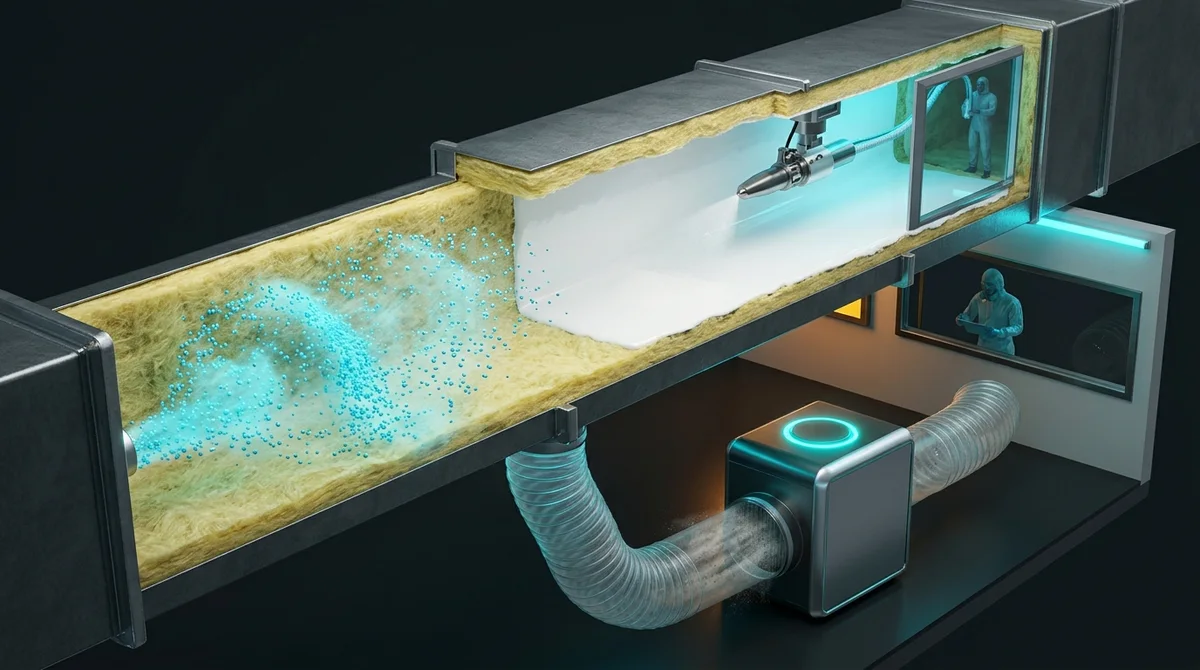 Scientific 3D Visualization: Electrostatic antimicrobial aerosol fogging and Sani Coat elastomeric fiber encapsulation under continuous HEPA containment.
4. Engineering Controls: Protecting Your Living Space During Service
Remediating air ducts inside a finished condominium requires clinical contamination control. Sani Effect Environmental deploys two critical mechanical safeguards throughout the entire procedure:
Commercial HEPA Air Scrubbers
High-volume, hospital-grade air scrubbers operate continuously under negative pressure. As dust and mold are disturbed inside the ductwork, powerful suction pulls dislodged particulates through 99.97% HEPA filters (capturing particles down to 0.3 microns), ensuring zero cross-contamination into condominium living areas or fine furnishings.
ActivePure® Sani Guardian Scrubbing
Simultaneously, portable Sani Guardian units powered by ActivePure® Advanced Photohydrolysis Technology actively sanitize the ambient condo atmosphere, neutralizing airborne microbial volatile organic compounds (MVOCs) and biological odors on contact.
5. The 4-Pillar Long-Term Condo Protection Strategy
Whether you select full duct replacement or clinical Sani Coat encapsulation, keeping a condominium healthy in Florida’s coastal climate requires continuous environmental management. Sani Effect prescribes a 4-pillar prevention protocol:
1. Relative Humidity Control (45%–55% RH)
Standard condo air conditioners cool but often short-cycle, leaving indoor humidity above 60%—the critical threshold for mold germination. Installing dedicated supplemental dehumidification (such as in-wall or whole-condo dehumidifiers) maintains indoor RH strictly between 45% and 55% year-round, eliminating duct sweating.
2. Exhaust Fan Inspection & Upgrades
Bathroom and kitchen exhaust fans must run at certified CFM airflow rates to exhaust spike moisture outdoors. In coastal Palm Beach, airborne salinity and continuous operation corrode internal motors and exterior backdraft dampers, causing outside humid air to seep backward into the condo. Replacing degraded fans restores proper negative bathroom pressure.
3. Independent Standalone HEPA Filtration
Central air conditioning filters only run when the thermostat calls for cooling. Operating independent commercial HEPA filtration systems continuously scrubs ambient particulate, dust, and pet dander from the air 24/7, starving potential fungal colonies of organic fuel.
4. Sani Duct Guardian (ActivePure®)
Installed directly inside the AC supply plenum, the Sani Duct Guardian leverages NASA-certified ActivePure® Advanced Photohydrolysis Technology. It continuously produces sub-microscopic purification molecules that travel through the entire duct network and into every room, actively neutralizing up to 99.9% of mold spores, viruses, and bacteria in the air and on surfaces 24/7.
Remediation Decision Matrix: Replacement vs. In-Situ Encapsulation
| Evaluation Criteria | Option 1: Complete Replacement | Option 2: Sani Coat Encapsulation |
|---|---|---|
| Health Reset Guarantee | 100% Virgin Materials | High Clinical Efficacy (Accessible Reaches) |
| Ceiling Drywall Impact | Major Demolition & Reconstruction | Zero Ceiling Demolition Required |
| Occupant Displacement | High (Multiple Days / Weeks) | Minimal (Same-Day / Controlled Zones) |
| Financial Investment | High (Ducts + Framing + Drywall + Paint) | Cost-Effective (Fraction of Reconstruction) |
| Condo HOA / COA Approvals | Permits & Building Architectural Review Required | Standard Mechanical Maintenance Access |
Connected Sani Effect IAQ Solutions
Palm Beach CertifiedExplore specialized indoor air quality services tailored for South Florida high-rise and condominium properties:
Air Duct Mold Remediation
HEPA extraction, botanical electrostatic sanitization, and antimicrobial encapsulation for residential ductwork.
Duct Remediation ProtocolSani BlueDuct System
R-8 flexible duct replacement with embedded Agion® antimicrobial silver-ion technology that suppresses microbial growth 24/7.
Explore BlueDuctHVAC Unit Sanitization
Deep coil sterilization, blower wheel micro-cleaning, and secondary drain pan restoration in condo air handlers.
Air Handler ProtocolScientific, Technical & Regulatory References
This technical analysis synthesizes consensus engineering standards and peer-reviewed clinical research on microbial amplification, indoor environmental hazards, and HVAC mechanical integrity:
National Air Duct Cleaners Association (2021). Assessment, Cleaning, and Restoration of HVAC Systems. Section 3.2.1: Prohibits abrasive rotary brushes on fibrous glass duct board and mandates resurfacing or encapsulation of porous airstream surfaces.
United States Environmental Protection Agency (EPA). Should You Have the Air Ducts in Your Home Cleaned? Explains that biological growth inside insulated or fiberglass ducts cannot be effectively vacuumed without risk of fiber detachment; replacement or specialized encapsulation is required.
Institute of Inspection, Cleaning and Restoration Certification. IICRC S520 Standard for Professional Mold Remediation. Details protocols for Condition 3 (visible/active fungal growth) on porous HVAC substrates, containment barriers, and negative air scrubbing.
American Society of Heating, Refrigerating and Air-Conditioning Engineers. ASHRAE Position Document on Filtration and Air Cleaning & Standard 62.2: Technical evidence on relative humidity thresholds, condensation limits, and bioaerosol mitigation in forced-air ventilation.
American Conference of Governmental Industrial Hygienists. Bioaerosols: Assessment and Control. Provides toxicological threshold guidelines for sub-micron fungal fragments, mycotoxins, and endotoxins circulating in residential mechanical plenums.
Lstiburek, J. (Building Science Press). Conditioned and Unconditioned Duct Systems in Humid Climates. Analyzes off-cycle vapor infiltration, interstitial dew point crossing, and fungal spore incubation across coastal Florida multi-family buildings.
WHO (2009). WHO Guidelines for Indoor Air Quality: Dampness and Mould. Comprehensive epidemiological evidence linking airborne microbial fragments, (1→3)-β-D-glucans, and MVOC exposure to respiratory illness and systemic immune reactions.
Gorny, R. L. et al. Fungal Fragments as Atmospheric Aerosols. Journal of Aerosol Science & Atmospheric Environment: Demonstrates that mold colonies release up to 300 times more sub-micron fungal fragments than intact spores into high-velocity ventilation airstreams.
Schedule a Forensic Condominium Duct Inspection
Notice black dust on your grills or persistent musty odors when your AC starts? Our licensed environmental specialists evaluate your fiberglass duct board, plenum transitions, and humidity balance with zero pressure and zero dispatch fees.